
Every creative work is influenced by its predecessors in some way. Fanzines are no exception. I’ve been communing with the fanzines on Fanac.com for months now and discovered a couple of magazines that kept readers updated on the world sf scene during the 1970s and 80s (and into the 2000s). Unless I find any magazines that predate them, these seem to be the first English-language ones to do this work. It’s wonderful to find the progenitors of Small Planet (after I started the magazine) and comb through their pages, finding fascinating columns on the “International Scene” and plans for World SF conferences.
I just happened to stumble upon Luna Monthly a few weeks ago, and what a treasure trove. Edited by Ann Dietz from June 1969 to the spring of 1977, Luna included an “International Scene” section, edited by Mark Purcell, which included reports from countries all over the world. Major world sf figures like Denmark’s Jannick Storm, Austria’s Franz Rottensteiner, England’s Gerald Bishop, and Norway’s Jon Bing regularly contributed, making Luna the hub of world sf news. December 1971 also saw Purcell’s first “SF in French” column, which continued until the penultimate issue (66, Winter 1976). Sometimes, the “International Scene” column was blended with the “SF in French” column, especially in the mid-70s. Purcell used this opportunity to inform Anglophone readers about the current state of French sf and review books that hadn’t yet been translated into English.
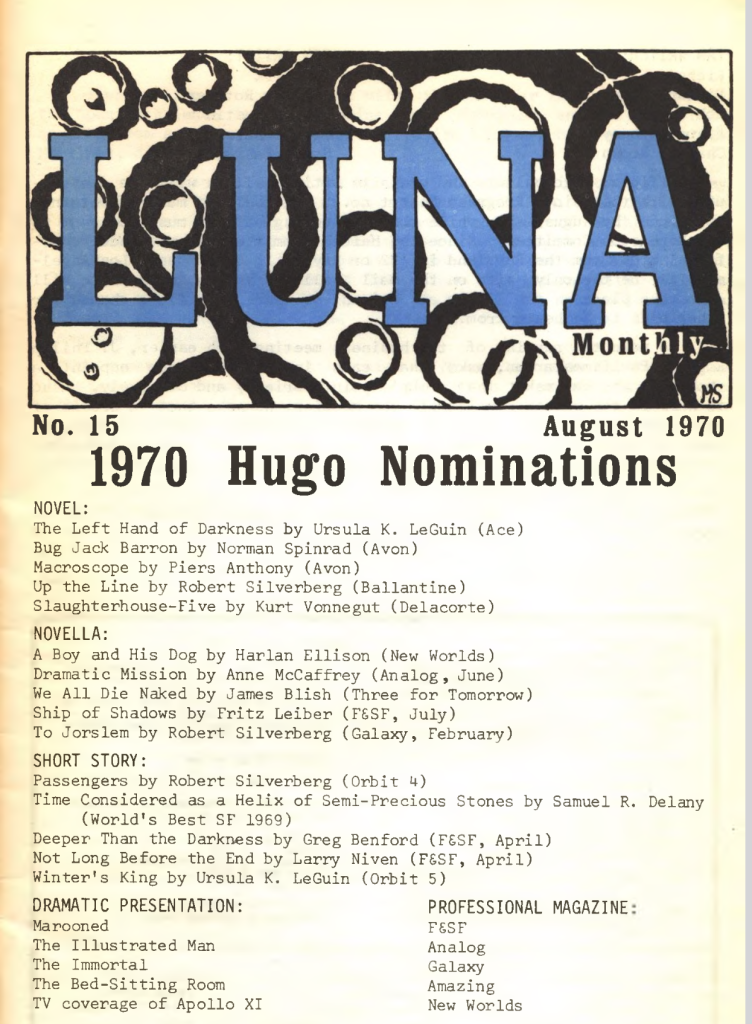
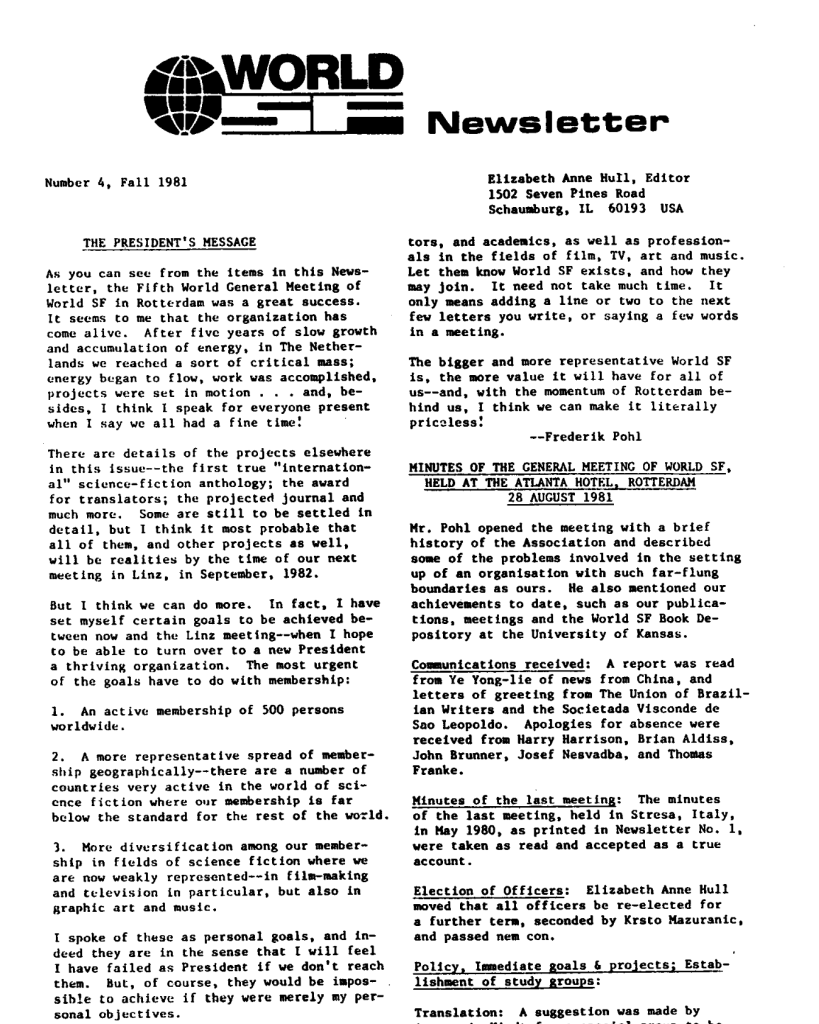
Luna closed not too long after the launch of the World SF Newsletter in 1976 by Brian Aldiss, Harry Harrison, and Frederik Pohl following the First World Science Fiction Writers Conference in Dublin. Unlike Luna, which was first and foremost a fanzine (essays, interviews, reviews, book lists), the World SF Newsletter was more of an announcement-based publication, with columns devoted to line-ups for conferences, as well as letters and essays by major sf figures from around the world discussing why the next conference should be in their city (see, for instance, the enthusiastic 1982 promotion for the Zagreb, Croatia conference). Efforts to gather material for a world sf anthology (which ultimately became The Penguin World Omnibus of Science Fiction, edited by Aldiss and Sam Lundwall, 1986) began in 1981, but the endeavor itself took several years, partly due to international copyright questions. [Interestingly, Don Wollheim’s The Best from the Rest of the World had already come out in 1976, just when the newsletter was starting, though Wollheim doesn’t seem to have had any affiliation with the organization. Wollheim had also started DAW in 1972 and published his first work of SFT, Pierre Barbet’s Baphomet’s Meteor in that same year.]
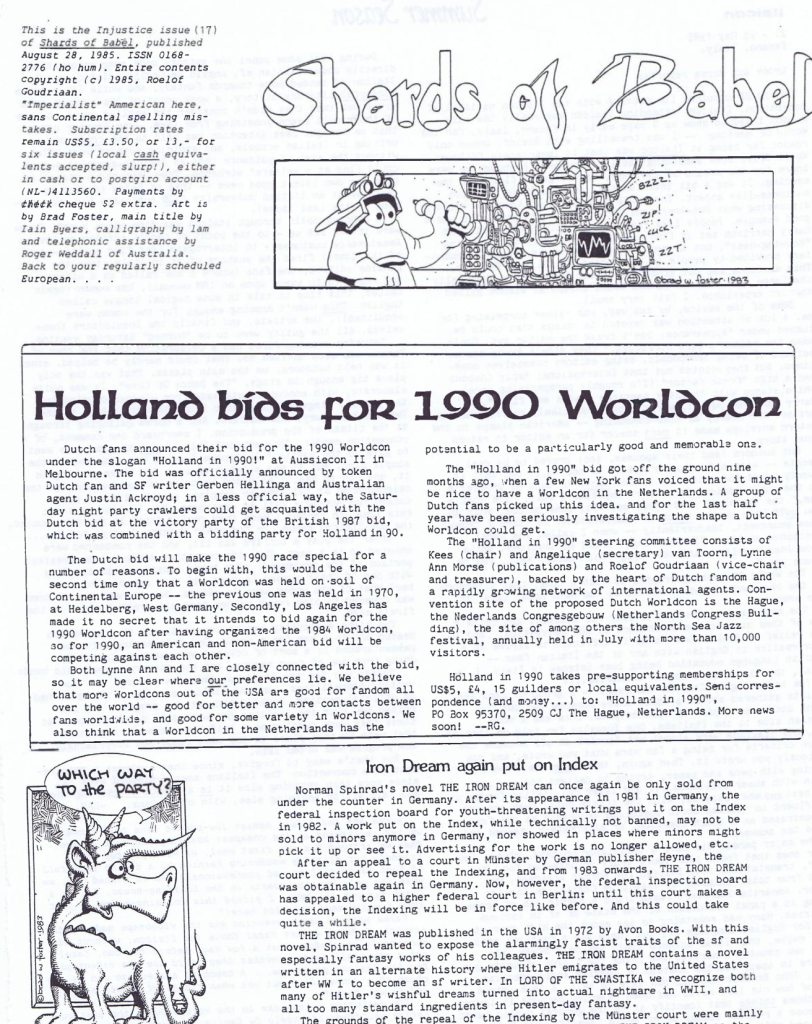
And then there’s Shards of Babel (1982-1995), a European fanzine published in English in the Netherlands by Roelof Goudriaan and Lynne Ann Morse. As Goudriaan explained in the first issue, he started the magazine because, in his words, “I’d like to come to know the fans next door, and their neighbours, and because I hope that is a feeling you share…” The plan was to include “news on people: writers, translators, fans, clubs…reviews of as yet untranslated Continental SF,” etc. It regularly printed news about the sf scenes in various European countries, the Worldcons and regional cons, as well as notices of new SFT magazines like SF International, started by William Wheeler.
The 1970s, as I’ve mentioned before in various mini-histories I’ve written about Anglophone efforts to promote awareness of world sf, was an incredibly prolific time. This was when Japan hosted the first international sf conference, when the World SF organization was formed, when the first three anthologies of SFT were published, and when Luna Monthly and the World SF Newsletter were going strong. This Cold War decade was a time of increased cooperation among sf enthusiasts, authors, editors, publishers, and translators, with the hope of forging a lasting bond across borders that would facilitate the easier flow of sf among all people.
Unfortunately, these efforts seemed to fall apart in the Anglophone world into the 80s and 90s, only to be revived in new ways (by Cheryl Morgan, Lavie Tidhar, Francesco Verso, and Alex Shvartsman) at the end of the first decade of the 21st century. At this point, in 2026, we’re still holding Worldcons mostly in the US and nearly every single Hugo and Nebula Award winner writes in English. And yet, you’re reading this on a website called “SF in Translation,” there’s a magazine dedicated to SFT and World SF, the BSFA and Locus have added translation categories to their awards, and publishers across the spectrum are regularly bringing out SFT each year, even if the numbers are relatively small. It’s crucial to know the history of these efforts if we’re to continue to successfully promote SFT and World sf going forward.
