
This website began with a list.
Back in 2014, when I began reviewing SFT for John DeNardo’s SF Signal, I realized that there were more works of genre in translation than I had ever realized. Being me, I started a list. Lists, I suppose, are a way of bringing order to the world and to our individual lives. They let us see, quickly and easily, what it is we’re trying to understand, whether it is how much SFT is out there or what we need to buy at the grocery store that day. The listicle is, of course, a cherished genre now, though also a stale one, but that’s beside the point. I love lists because they are a way to organize one’s thoughts. They help me feel like I have control over my life.
But sometimes lists become unwieldy. I quickly found that, if I used the term “speculative fiction” and included works of science fiction, fantasy, horror, and magical realism in my list, it became too long. The solution? A spreadsheet, of course! After all, if lists help you organize your thoughts, spreadsheets give you the ability to include a lot of information that you can manipulate via graphs and charts. I’m no spreadsheet genius, but I love using them to find out, for instance, how many SFT novels are out this year compared to last year, or what the long-term trend is in single-author SFT collections. My SFT spreadsheets help me bring order to what would otherwise be, for me, an overwhelming cascade of translated fiction (yes, there really is that much).
If you look at the SFT spreadsheets I’ve created, you’ll see that I invite contributors to let me know which titles need to be included, or if I’ve made a mistake (as in, this title is from Argentina, not Spain, etc.). I create separate tabs for long-form and short-form SFT, and in the short-form tab, I split my lists between those stories published in magazines and non-SFT anthologies, on the one hand, and those that are part of collections or SFT anthologies, on the other. This information helps me understand if a particular year has seen a lot of SFT from different authors (potentially published in a wide array of magazines/websites) or if one or two authors are dominating that year with thick collections (think Buzzati or Agualusa).
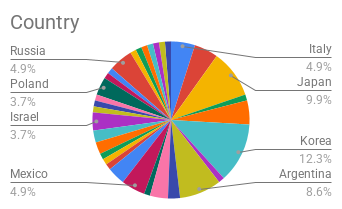
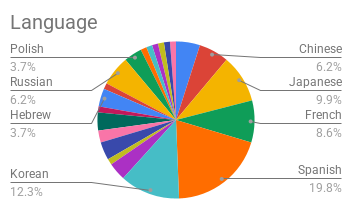
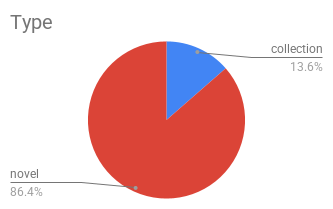
Spreadsheets help me keep track of my own reading, which titles I’ve reviewed, which books I plan on reviewing, and how many that year are novels, collections, anthologies, and stand-alone short stories. One can easily see on a spreadsheet if, for example, Korean SFT is dominating that year or the past few years, or if an author has been prominent for four or five years and then dropped off the radar. Still, I sometimes feel overwhelmed by all of this information. For instance, according to the “short-fic” tab, I’ve cataloged 3,909 works of short SFT from 65 unique languages. That’s a LOT of short SFT, and impossible for me to wrap my brain around. The lovely pie charts that my spreadsheet generates, though, help me see quickly that Spanish SFT dominates with 15.5% of all translated short fiction; China, Japan, and Italy have brought us the most short SFT; and of the 1,494 unique authors, Etgar Keret (Hebrew), Moacyr Scliar (Portuguese), and Dino Buzzati (Italian) have given us the highest number of short stories.
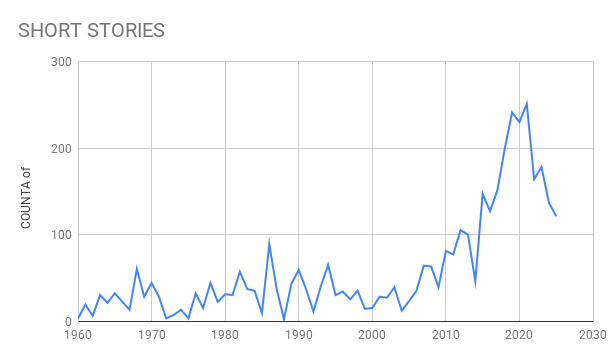
I drop pie charts and line graphs at the bottom of each tab to help me make sense of what’s coming out each year. I’m especially interested in the line graphs at the bottom of the “short-fic” and “all-long-form” tabs, since they show me the long-term trends with these kinds of SFT. Both have sharp spikes around 2017-2019, in keeping with a clear burst of enthusiasm for SFT generally at the end of the 2010s. As I’ve written before, these sudden bursts seem to come once every few decades, likely because of a combination of geopolitical events and editors or publishers who happen to be enthusiastic about world literature, with a particular interest in speculative fiction.
My dissertation was on turn-of-the-twentieth-century American literary naturalism and opera, and I did so-so in my high school statistics class. And yet, here I am, tracking and writing about SF in translation because I’ve always loved science fiction (specifically) and foreign languages. And LISTS. I mean, I was writing lists of potential names I’d give to my children when I was a tween, and keeping lists of what I was reading next to my teetering piles of books on my nightstand when I was a teen. I also found quite fun to surreptitiously manipulate my mom’s shopping lists (resulting in much consternation on her part and much laughter on mine). So now you know where I’m coming from. My site is filled with lists and spreadsheets and analyses of those lists and spreadsheets. I use those to spread the word about SFT and understand the short-term and long-term trends. Hopefully, this helps all of you, my readers, and those interested in speculative fiction and world fiction, generally, find more wonderful things to read and gain some understanding of what is being published and why.
