
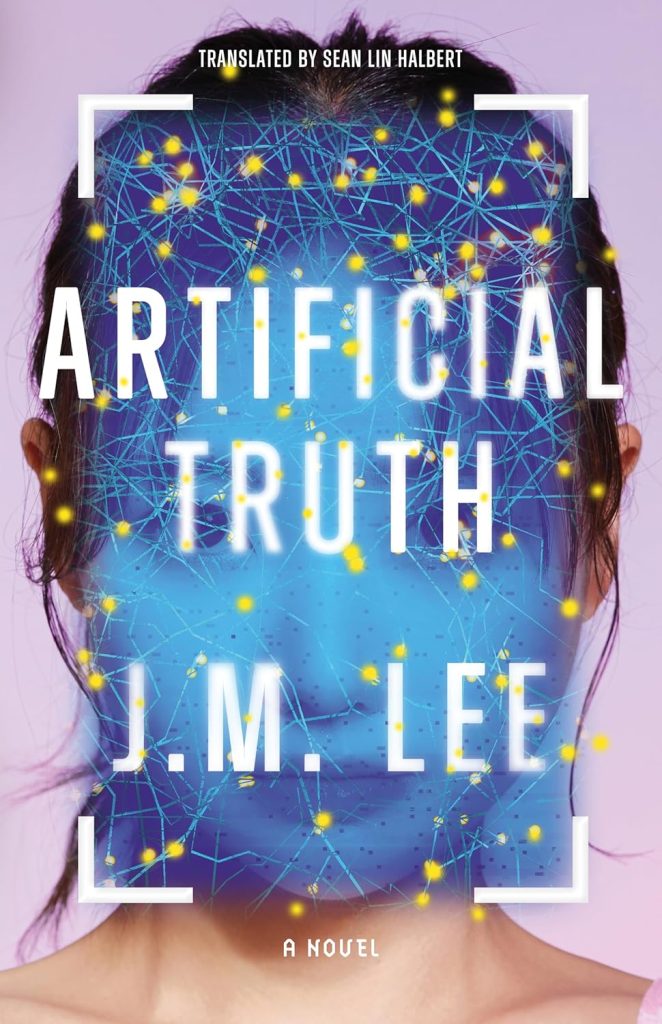
translated by Sean Lin Halbert
original publication (in Korean): 2024
first English edition: 2025, Amazon Crossing
220 pages
grab a copy here or through your local independent bookstore or library
“On March 13, 2016, at 5:44 p.m., at the Four Seasons Hotel, Seoul, history happened.”
This statement opens the “Author’s Note” at the end of Artificial Truth, reminding the reader of something that one of the main characters mentions early on in the novel, something that the author believes will mark a major turning point in the relationship between humans and AI: that moment in 2016 when Lee Sedol (one of the world’s top Go players) beat AlphaGo, Google DeepMind’s AI Go program. As J. M. Lee explains, “it was humanity’s sole victory in seventy-four matches against the artificial intelligence–humanity’s last triumph, I call it.”
Around this immense but also depressing triumph, Lee has built a complicated, at times metafictional, novel about what it means to maintain one’s humanity against a motivated and “evil” AI. Told from several points of view (the three main characters and even the AI narrate their own chapters), Artificial Truth is the story of KC, a brilliant programmer who sets his sights on using artificial intelligence to create a superintelligent human–basically a new species, though a new step in evolution. After finding out that he has terminal cancer, KC illegally uses nanobots on his own brain to map his neural network and upload it to an AI program. The problem, as KC realizes after he “wakes up” in the digital space, is that, having refused treatment, he was in a terrible state of pain and depression and the AI learned from him then.
At first, the AI (whom KC calls “Allen”) is KC: they have the same likes and dislikes, opinions, and decisions–but that’s because KC is the AI’s “mentor.” Eventually, though, Allen starts to diverge from KC in order to wreak havoc in the real world through phones, cameras, computers, and a vast virtual world called “Alegria.” The goal: destroy Minju, KC’s wife, who took care of him before he died and who then remarried.
A book about humanity literally fighting for its life against AI, Artificial Truth frequently references human artistic creations like the novels of Thomas Mann (the best!), Marcel Proust, and Fyodor Dostoyevsky, as well as the music of Ludwig von Beethoven. Minju becomes involved in art through an exhibition hall that she inherits after her husband’s death, and the man she eventually marries is an amateur photographer (named Junmo). Allen, believing that Minju killed him/KC with an overdose of painkillers, sets up what Lee states is a Hamlet situation by trying to make Junmo jealous and paranoid. Given that Junmo was a hitman for hire and general criminal before reforming and then marrying Minju, Allen doesn’t think that this will be very hard.
What follows are chapters in which Minju and Junmo try to understand why strange things are happening (packages are delivered to their house that they didn’t order, Minju’s car blows up) while KC explores what it means to be “alive” even though he no longer has a body. Freed from the pain and depression that he’d felt leading up to his death, he now realizes the colossal mistake he made in training Allen on himself in that state of mind and does what he can to warn Minju against Allen. For most of the book, we think that Minju and Junmo are just Allen’s pawns, growing more paranoid and violent with each other because of his manipulation of them through the technology that surrounds them.
If I had read the “Author’s Note” before the book itself (as I sometimes do), I would have seen much earlier (I hope!) that Lee is playing a much more complicated game with his readers. I would have also understood that Artificial Truth is not simply a dystopian novel offering us a terrifying vision of AI’s power but also an affirmation of human ingenuity and morality. Indeed, Minju and Junmo don’t just resist the AI’s machinations but also manipulate it themselves. Sometimes, happy endings in dystopian novels seem trite, but in this case, it will make you want to cheer for Team Humanity. Artificial Truth is a testament to human wins, literally and figuratively, something that we need right about now. Also, if you haven’t yet, go read World Literature Today’s latest issue on “World Lit in the Age of AI.”
