
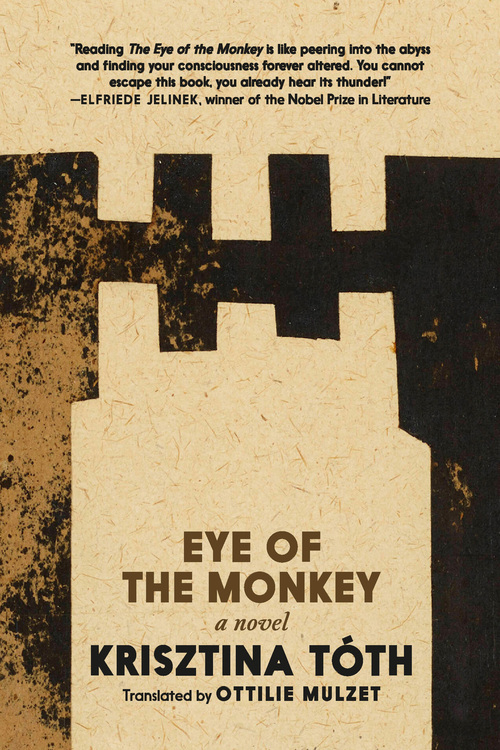
translated by Ottilie Mulzet
original publication (in Hungarian): 2022
first English edition: 2025, Seven Stories Press
304 pages
grab a copy here or through your local independent bookstore or library
Eye of the Monkey, Hungarian author Krisztina Tóth’s first novel to be translated into English, could have been one of the best works of SFT of 2025. Its exploration of government oppression, memory, history, education, relationships, and environmental catastrophe set it up to be a timely, fascinating look at an unnamed society’s descent into isolation and paranoia. Instead, the book is a series of seemingly-disconnected portraits of several different characters, all of whom are struggling with some sort of loss. Only at the end do we understand how they all fit together, but by that point, this reader had lost interest.
Set in an unnamed country at some point in the future, Eye of the Monkey focuses on a psychiatrist, Dr. Mihály Kreutzer, and his patient, Gizella, as they each have to deal with their own familial problems and then begin their own complicated and disturbing relationship. A sex addict who records his many conquests in notebooks, complete with lewd pictures and descriptions, Kreutzer is also a good friend to the Regent, who, since the end of the Civil War, has presided over the United Regency. Apparently Kreutzer has been treating the Regent’s wife for her bipolar issues and the Regent himself for other problems. Since the end of the war, the wealthy and well-to-do live in “protected zones,” while the poor are left to fight over scraps in the dangerous areas.
Meanwhile Gizella, a professor of Modern History at the New University, is unhappy in her marriage to an older, predictable man and is also being followed by a young man who claims she is his mother. In the course of her talks with Kreutzer, we learn that her parents divorced when she was young and her sister went to live with her father. Though she discusses this almost without emotion, her description of what happened reveals that the incident affected her profoundly.
Kreutzer himself is in the process of getting divorced, and when his mother passes away, he is stuck cleaning out her cramped, dirty apartment. In the process, he remembers what happened when his younger brother died, and his tone is similar to Gizella’s when she talks about her own past.
Both Kreutzer and Gizella are members of the well-to-do class, living in protected zones and benefiting from special IDs that allow them to travel freely and shop in certain stores. Apparently, after the establishment of the Unified Regency, very few people have been allowed to leave the country. The main characters, all middle-aged, very clearly remember what life was like before the war, when shops and streets were filled with people. We get the sense that they are just stopping themselves from tipping over into nostalgia, as if even that thought would get them in trouble.
One of the most disappointing things about this book is how Tóth never follows through on the intriguing trope of brain/body disconnection. Early in the novel, we learn that Kreutzer feels that though “he was psychically well-balanced, with a nearly detached relationship to his own body, he was observing the signs of his own aging with anxiety.” Later on, we learn that his favorite image, which he has hung on the wall throughout his life, is of a monkey who had been part of a famous head-transplant experiment in 1970. The portrait of the monkey grips Kreutzer because it shows
that moment when the wondering, dumbfounded soul, clashing with the impossibilities of this world, arrived, or more precisely returned to a fractured, tortured body stitched together from two parts. This is what had enthralled the doctor so much, even as a schoolboy, and what he had clung to ever since then: this image enshrining that moment of awakening.
One gets the sense that all of the characters depicted in this novel–Kreutzer and Gizella, their spouses, the cleaning lady, Kreutzer’s mother, the man who follows Gizella, the Regent himself–are like this monkey in that they are made up of two halves working together but not in harmony. The story itself, too, seems to work in this way, with lyrical passages like the one just quoted dropped in to a larger narrative in which events are described in a plodding, laborious way. One wonders, for example, exactly what the point is of the long passage near the end about Kreutzer trying to put together a sleep sofa.
In keeping with the secrecy and oppression that governs this country, a catastrophic failure at one of the power plants threatens everyone, but the people are told only to stay indoors. Kreutzer, we learn, has been tasked with interviewing people who are willing to go on a suicide mission to help contain the problem. By the time the government realizes the extent of the threat, it’s already too late to evacuate everyone and get them to safety. The novel ends with Kreutzer himself being told that he, too, must put himself in danger, otherwise his sexual escapades will be made public.
Tóth depicts a society of lost souls, wandering around looking for meaning, feeling detached from their pasts (which still haunt them) but struggling to move forward in order to raise children and pursue relationships. Nonetheless, the novel never brings the various threads together into a coherent, compelling narrative that makes us care about what happens to the characters.
