
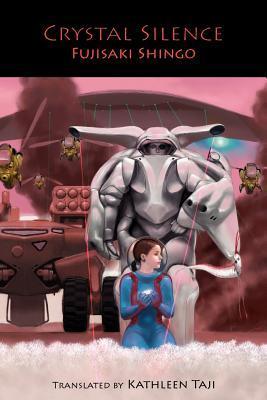
translated by Kathleen Taji
original publication (in Japanese): 1999
first English edition: 2012, Kurodahan Press
344 pages
grab a copy here or through your local independent bookstore or library
Crystal Silence is one of the many excellent works of Japanese sf in translation published by the now-sadly-shuttered Kurodahan Press. Sprawling, technically detailed, and ambitious, Fujisaki Shingo’s story about Martian colonies, alien life, artificial intelligence, archaeology, and connection (whether between humans or humans and AI) will leave you wishing that this had been a tetralogy instead of a single novel.
Set in 2071, Crystal Silence imagines that the US, Japan, Russia, and China have established colonies on Mars with the goal of eventually terraforming the Red Planet. India, Australia, Canada, and the EU have come later, and the struggle over dominance has been raging ever since. Now, all of the major powers have set their sights on the northern polar ice cap, hoping to secure the water for themselves.
When the story begins, Japanese archaeologist Saya Askai is contacted by Mars researchers about coming to the planet to help them understand a strange cache of fossils they recently found. Askai’s work on the Jōmon period (a ten-thousand-year span of peace and cultural flowering on the Japanese archipelago from c. 14,000 and 300 BCE) and her translation of the pottery shard designs into a multisensorial virtual artwork have made her the perfect candidate to help the researchers make sense of both these fossils and some strange “crystal flowers” that have sprung up outside of the various countries’ domes.
Before leaving Earth, Askai must tell her boyfriend Keren Su that she’s leaving and doesn’t know when she’ll be back. What she doesn’t know (and won’t figure out for a while on Mars) is that Keren isn’t human. In fact, he’s what people call “wetware”–a human clone whose brain is designed to function both in the virtual space (Verdig) and the physical word. In 2071, the virtual reality network is so all-encompassing on Earth, that people can spend nearly their entire lives there. Keren is just one manifestation of a program that can inhabit the internet and the other offshoots of the network.
Keren’s enemy is the weapons manufacturer Tsukada, who himself was designed as wetware but was stolen just before the process was completed. His rage at not feeling fully human has driven him to try and wipe out humanity (and all organic life) in the universe.
Meanwhile, on Mars, Askai learns that the crystal flowers, and then the quasi-Schwartzchild spheres that have engulfed the major colonies’ domes, may be connected to the First Martians, whom researches theorize arrived at the Red Planet millions of years ago to colonize it because it was already a dying landscape. Rather than interrupting the developing life on Earth, they decided to live on Mars as long as possible and then, perhaps, moved into a virtual network running on gravitational waves (which would explain the strange gravitational waves picked up by Earth equipment). Human meddling on their planet might have set off a series of events designed to force the Earthlings back to their planet.
Though all of the technical descriptions of virtual reality networks, quasi-Schwartschild spheres, gravitational waves, and crystal flowers are fascinating, the core story here revolves around what it means to be human and to have meaningful connections to other humans. Askai herself was traumatized as a child when her father abruptly left and her mother terminated the AI who had become Askai’s best friend. Keren has connected himself to Askai because he feels responsible for keeping her safe, though he keeps his origins from her out of fear that she’ll reject him. Tsukada channels his rage into destroying all life in the universe because he feels betrayed by his creators. Ultimately, Askai learns (from Keren) that the AI who was deleted was never really gone, but lives inside of her memories. Askai comes to terms with who Keren is, though his human body is destroyed by Tsukuda.
Near the end of the book, Askai reflects on the raging battles, viruses, Martian(?) flowers and spheres, and her own many near-death experiences: she’s been dealing with “[a]n agent [Keren] with intellectual powers and high emotional intelligence surpassing those of his human creators, a brutal and inhuman man called tsukada.bak, and those strange artificial life forms that had jumped into a network, which belonged to Martians who used gravity as a medium” (340). Askai then connects what has happened on Mars to the transformation of Japan thousands of years before: “The people from the Asian continent had crossed the sea and come to Japan in the mists of time, destroying the peaceful lives of the Jōmon people that had lasted for ten thousand years. In the same way, mankind had destroyed the world of the Martians, who had lived quietly here for hundreds of millions of years” (340-41).
An ambitious, fascinating look at what the future might look like for Earth and Mars, Crystal Silence is well worth the read.

1 comment on “Review: Crystal Silence by Fujisaki Shingo”