
edited by Heather Dubnick
translated by: see below
Kurodahan Press, 2019
238 pages
grab a copy online or through your library
Contents:
“Introduction” by Raechel Dumas
“A Cultural Dynasty of Beautiful Vampires: Japan’s acceptance, Modifications, and Adaptations of Vampires” by Shimokusu Masaya
“Blue Lady” by Inoue Masahiko, tr. Neil Webb
“Kingdom” by Asukabe Katsunori, tr. Laura Wolly Dominguez
“The Stone Castle” by Kikuchi Hideyuki, tr. Jonathan Bunt
“The One-Legged Woman” by Okamoto Kido, tr. Neil Webb
“Vampire” by Hikage Jokichi, tr. Jo Ash
“The Crimson Cloak” by Asamatsu Ken, tr. Aragorn Quinn
“Vow” by Sunaga Asahiko, tr. Irit Weinberg
“The Husk Heir” by Kaijo Shinjim tr. Ben Cagan
“A Piece of Butterfly’s Wing” by Kamon Nanami, tr. Angus Turvill
“Unnatural” by Okuda Tetsuya, tr. Hayley Scanlon
“Paradise Missing” by Iino Fumihiko, tr. Lucy Galbraith
“Dracula’s House” by Fukuzawa Tetsuzo, tr. Irit Weinberg
“Birth of a Vampire” by Konaka Chiaki, tr. Lauren Barrett
“Halvires” by Mikawa Yu, tr. Jonathan Bunt
“Parasol” by Inoue Masahiko, tr. Yan Yijun
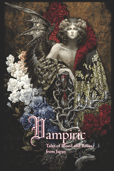
Vampiric: Tales of Blood and Roses from Japan is an excellent introduction to the modern vampire tale in Japan. From horror to science fiction, impressionistic sketches to fully-developed stories, these tales demonstrate the range of creative ways in which authors can explore the vampire figure. As Raechel Dumas explains in her introduction to the anthology, vampires, “while a relatively new addition to Japan…[have] gained increasing traction in the fiction imagination, having been widely adopted and adapted from the latter half of the twentieth century to the present.” After all, “traditional Japanese culture is rife with elements that anticipate the assimilation of the vampire into modern lore,” including various monstrous creatures like the oni (ogre or demon), yamauba (mountain witch), and gaki (hungry ghost). Since Western depictions of the vampire entered Japanese culture following World War II, Japanese writers have taken them up and adapted them in a multitude of creative ways to explore various modern-day concerns about love, relationships, family, friendship, and more.
Some of my favorite stories from this anthology consider what it might be like to be a “half-vampire” or someone who doesn’t realize, for a time, that they actually are a vampire. According to the narrator of “Halvires,” being the offspring of only one vampire means that you can’t be harmed by sunlight or crucifixes or garlic, though the sun does restrict you. Your vampiric nature, though, does give you unbelievable strength. In “Birth of a Vampire,” Michiru, a student with a part-time job runs into a strange woman who says she’s a model-turned-photographer. Convincing Michiru to come with her to her house to pose for photographs, the woman realizes, too late, that the girl she’s kidnapped and whose blood she intends to suck is actually…herself a vampire. The shift in perspective from a story about a helpless girl to a terrifying vampire makes this one of the more remarkable stories.
Several stories are set centuries before, like “The One-Legged Woman” and “The Crimson Cloak,” or in the recent past, like “Vampire,” set just after World War II. “The Stone Castle,” set during the samurai era of medieval Japan, imagines a man searching for his master and instead coming across a land whose people have been turned into vampires. This man must face down the vampire in his castle on the hill in order to save Japan from the fate of the farmers.
The shortest stories–“Blue Lady” and “Vow”–offer us impressionistic snapshots of vampiric life. In the former, the owner of a bar has put into practice an idea he got from science fiction stories. Using lifelike android women, he has placed alcohol in their necks so that customers can suck it out like drinking blood. His discussion with a customer about how to tweak the way the bar is run makes this story darkly humorous. “Vow,” however, is a haunting tale about a vampire who advertises for young men who can play the harpsichord. Inviting his vampire friends, he has the man play a beautiful concert before allowing the others to feast on his blood (thus turning him, as well, into a vampire).
Several of the stories explore dysfunctional families or families that are torn apart because of one person’s vampiric tendencies. “A Piece of Butterfly’s Wing,” which won the 2011 Kurodahan Press Translation Prize, explores a woman’s tragic discovery after seeking out her runaway sister. In
Paradise Missing,” two couples discuss the strange happenings in their neighborhood after a husband, who was apparently devoted to his wife, disappears after she dies in a strange accident. Later, the coroner finds that she was pregnant with what looks like…a small but exact version of her husband. “Halvires,” discussed earlier, has as its main premise the half-vampire siblings setting out to kill their father so that he stops bringing more of their kind into the world.
One of the most entertaining stories, written like a typical horror tale, is “The Husk Heir.” Set in modern times, it follows the trials and tribulations of Isaku, an employee of Odyssey Industrial Waste LLC. Angry at his boss for sending him out at night alone to drop a load of old tires on a strange promontory, Isaku encounters a community that claims that its women and children were fed upon by a vampire (the “Husk Lord”). In a darkly humorous moment, the men at the bar who tell Isaku their story realize that he works for the company that has been dropping old tires nearby, causing swarms of mosquitoes to form. One aggressive, angry man yells at Isaku, “Just when we think we’ve dealt with the Husk Lord, look, a new swarm of bloodsuckers springs up” (131). They chase him out of the bar, where Isaku encounters a strange man who just so happens to be bringing some blood to a home on the promontory. After the man falls over a cliff, Isaku decides to take the blood to its destination, where he finds a strange woman and her brother (who is in a coffin). She uses the blood to revive her brother, who is angry with her because he doesn’t want to feed on people. Nonetheless, she tells him, you have to continue the family business. The vampire runs outside and is then attacked by mosquitoes. Isaku runs, thinking he can escape, but is then bitten by a rabbit, and then a cow and a horse. His last thought is about his boss: “Araki, when I become a vampire I’m coming straight for you” (143).
At times entertaining and terrifying, Vampiric is one of the many Kurodahan Press books that you need to read. It’s a bit difficult to find a copy to buy online (you can find some copies on Worldcat) but it’s worth it to try and find one.
