
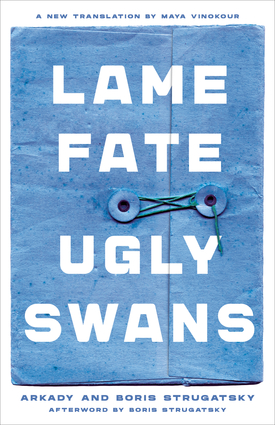
translated by Maya Vinokour
original publication (in Russian): 1989 (LF), 1972 (US)
first English edition: 2020, Chicago Review Press
grab a copy here or through your local independent bookstore or library
After reading the remarkable nested novel Lame Fate/Ugly Swans, I decided to make a list of the other Strugatsky works that I’ve read so far:
Monday Starts on Saturday (tr Andrew Bromfield)
The Snail on the Slope (tr Olena Bormashenko)
The Inhabited Island (tr Andrew Bromfield)
The Dead Mountaineer’s Inn (tr Josh Billings)
Roadside Picnic (tr Olena Bormashenko)
The Waves Extinguish the Wind (tr Daniels Umanovskis)
The variety of genres and styles with which the Strugatskys (successfully) experimented is astonishing. Working together for decades, the translator from Japanese and the astronomer imagined humanity finding the strange and absurd both on other planets and our own. Their most popular novel in English translation, Roadside Picnic, adapted for the screen by Andrei Tarkovsky in the 1979 film Stalker, asks us to imagine the aftermath of a supposed alien fly-by, in which “someone” accidentally/deliberately dropped objects on Earth that defy the laws of physics as we understand them. One man (Red) regularly enters these strange zones in order to extract the valuable objects and sell them.
The two main characters in the skillfully translated Lame Fate/Ugly Swans remind me a bit of Red, with his jaded attitude that doesn’t get in the way of his constant drive to make money. For both Felix Sorokin (LF) and Victor Banev (US), though, money isn’t the issue anymore so much as their reputations and futures as writers. As Boris Strugatsky writes in his Afterword to the nested text, the complicated publishing history of both LF and US made the two stories perfect for one another. While LF appeared in the magazine Neva in 1986, to the authors’ surprise but likely (according to Boris) because of the new societal openness brought about by perestroika, US was never going to be published. Despite the brothers shopping it around, there were no takers. Eventually, the Strugatskys decided that US was perfect for the role of the Blue Folder: Felix Sorokin’s hidden masterpiece in LF. After all, “It, too, was the story of a writer living in a totalitarian state. It was sufficiently fantastical while also being entirely realistic. And, in essence, it dealt with the very same questions and problems that tormented Felix Sorokin” (376).
The sense of exhaustion and dismal disappointment that pervade LF/US might be due to what translator Maya Vinokour explains was the brothers’ shift away from a “faith in scientific and social progress” to what the two saw as the ” ‘appallingly banal, bureaucratic, imperfect, and spiritually bankrupt’ life they observed all around them in the Soviet Union” by the late 1960s and 1970s (Introduction, viii). One cannot forget, either, that the two lived through the trauma of World War II and the Siege of Leningrad (1941-1944). At various points in US, Banev remembers the horrors of war: bombs that destroy buildings you just walked past, friends killed in battle. This past seems to weigh heavily on him, blending almost unsurprisingly into the doomed situation in his hometown where a strange group of people has somehow captured the imaginations of its teenagers.
But first Lame Fate: Felix Sorokin, a somewhat successful author, is being pressured by the writers’ union to submit a manuscript to a new computer program that will determine its worth. Felix, along with his colleagues and friends, tries to understand exactly what he’s getting into before actually doing this. As one colleague darkly imagines, the manuscripts are not being used to help build the computer at all: “actually, the robotic editor himself as already been created, and now they’re just using our manuscripts to train him. And when that machine becomes operational, that’s when it’s curtains for us, dear sirs, because it’s not just going to fix grammar mistakes or improve style, it’ll be able to sniff out subtext from a mile away” (84). Ultimately, according to the suspicious Valya Demchenko, the machine is a robot censor, ready to pounce and denounce. Felix isn’t completely convinced by Valya’s argument and, after days and weeks of procrastination (he went to a restaurant on the other side of town and can’t get to the office in time, his friend called, etc.), Felix finally shows up to submit his manuscript. What he brings, though, is a review he wrote a long time ago, and the score that it receives after being fed into the machine is…low. Only later does Felix learn from the man in charge, Mikhail Afanasyevich, that the “machine determines not the absolute artistic value of a work but only its fate in the forseeable historical future” (332). Felix, then, could write the most sparklingly intelligent, intellectually bold, and beautifully styled text ever written in the history of humanity, but if it is only published in one review journal and read by three people, its score is…4. If, however, he had been Pushkin, whose work was read by millions, including generation after generation of schoolchildren, the score would have many digits. That, Mikhail Afanasyevich explains, is what the machine is interested in calculating.
Anyone not living under a rock in 2026 will inevitably think about the argument that’s been simmering for years over intellectual property and Google/AI companies’ attempts to suck up and digitize as many texts as they can in order to train their systems, which then spit the information back to us. The point in LF, though, is that texts, whether high art or lowbrow entertainment, can only have an effect on readers if they have readers–see Boris Strugatsky’s Afterword about writing texts for the drawer. But one doesn’t have to have one’s hopes as a writer crushed if one never sends a manuscript off to get rejected. As Felix wonders at one point, “what if my Blue Folder, my secret pride, my strange hope against hope is no mutton at all but the same old dog meat, just from a different slaughterhouse?” (145). Does he dare actually submit the contents of the Blue Folder (what we know as Ugly Swans), knowing that it is so strange and unsettling that people may not want to read it at all?
Thankfully, we readers get to sink our teeth into Ugly Swans, and yes indeed, it is strange. The Strugatskys have this way, especially in texts like The Waves Extinguish the Wind, of writing about the alien and unknowable in such a way that the reader just wants to grab the authors by the shoulders and yell what exactly is going on here??? It’s like Ugly Swans is a text angled not quite in the world of understandable events. Nothing is ever fully explained…we just get hints of horror, which, of course, ratchets up the fear. We sense throughout US that something truly terrifying is just around the corner, but even when it seems to come at the end, we are trapped in Victor Banev’s perspective, one that we would like to escape (especially because he spends most of his story drunk or lamenting the fact that he was so drunk).
Returning to his hometown after finding some success as an author and screenwriter, Victor falls in with a strange cast of characters, some of whom are friends just because he’s known them for so long, while others run various parts of the local government. Told by his ex-wife that he must find a boarding school or something for their daughter Irma in order to get her away from the unsettling influence of the town’s “clammies,” Victor learns quickly that Irma is not alone in her strange behavior. Invited to a school gym to give a talk about writing, Victor encounters a large group of intellectually over-mature teenagers who demand that he answer questions about progress and intellectual capacity. They are uninterested in the past, seeing it not as hampering the future but simply not even worth sweeping away. All of this seems to be happening because of the “clammies,” a group of sickly-looking men who have been living in the city’s leprosarium. They wear dark glasses and scarves, and their skin is unusual. The teenagers have started to treat their parents with what Victor calls “intellectual cruelty,” dismissing everything that they’ve been taught as uninteresting and irrelevant. Because it’s teenagers, the parents aren’t sure if this is just the usual bad attitude or something more sinister. Eventually, even the town leaders start to get scared, especially since something has been wrong with the weather for a very long time–the rain just doesn’t seem to stop. Things don’t grow like they should. The adults are starting to blame the clammies and a riot seems to be brewing.
For Victor, the events of the town make him self-reflective–he and his friends sit around at the Club trying to think about where they went wrong. According to Pavor, humanity is “ideologically bankrupt…it’s always pining after and demanding gods and leaders, law and order, and every time it gets its gods, leaders, law, and order, it becomes dissatisfied, because it actually doesn’t give a good goddamn about any of those” (205). Humanity, according to Pavor, has never changed and never will. The clammies offer something new, and that’s why the teenagers are drawn to them. Victor, though, can’t imagine a world in which history is considered irrelevant–it’s what the world is based on, what art, science, politics, and everything else have come out of. Without history, nothing would exist. He realizes
Yes, I hate the old world. I hate its stupidity, its indifference, its ignorance, its fascism. But what am I without all that? It’s my bread and water. Cleanse the world around me, make it look the way I’d want it to, and it’s all over for me. ..The new world is austere, just, clever, perfectly clean—but it’s not a world that needs me; I’m a zero in it. It needed me when I fought for it…and if it doesn’t need me, then I don’t need it either. But if I don’t need it, why am I fighting for it? I miss the good old days when you could spend your life building a new world, then die in the old one. Acceleration, man, it’s everywhere…But how can you fight against without fighting for? (358)
Felix Sorokin has to find a reason to continue moving through each day, writing steadily, knowing that what he thinks is his masterpiece may never be read. Victor Banev must confront the fact that everything he’s done in life–fighting for his country, producing books that readers have enjoyed–may be worth nothing in the face of a likely alien presence that may be using young people to shift humanity onto a different course. As always, the Strugatskys here offer us a compelling, intellectually-rich literary text that encourages us to think about the larger questions in life: what kind of meaning can we make for ourselves in life? What is our work worth? How do we fit into history and how can we make a better future? Lame Fate/Ugly Swans is the kind of book that needs to be read at least three times before it can really sink in and also unfurl its many meanings and questions. It must take its place in line after The Magic Mountain and His Master’s Voice, for me, but I know I’ll come back to it eventually.
