
July 28, 2026
Get your copy here
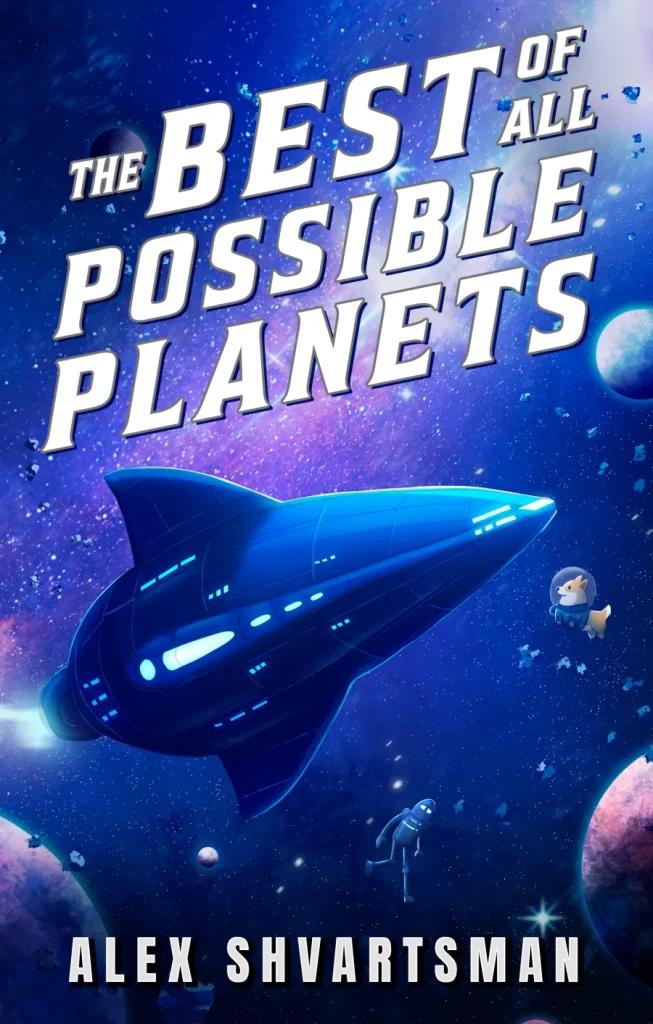
I haven’t had this much fun reading a book since…well, honestly, I can’t remember. A rollicking space adventure complete with eminently satisfying references to and parodies of the greatest science fiction stories of the twentieth and twenty-first centuries, The Best of All Possible Planets will turn you into one of those people who laughs out loud while reading a book in public, startling the people around you. They’ll look at you funny, but you won’t care, because you’re enjoying yourself too much. After all, this is, according to the author himself, “a space opera take on Candide written as a series of Futurama episodes.”
You can tell that Shvartsman had a wonderful time writing TBoaPP. Each chapter begins with a quote from The Gathered Wisdom of the Human Species by an old sage named Airvolt, who has taken on the role of philosopher-leader in the tiny human settlement that is all that’s left of our species on Earth. Apparently, the minute humans figured out actual space travel, they hightailed it off the planet, leaving only those who weren’t as…ambitious. These pearls of wisdom dropped by Airvolt include, for instance, explanations like “instead of building the pyramids, the [ancient aliens] demolished the upper tier of the Stonehenge, burned the Library of Alexandria, and glued the king’s tomb to the ceiling of the Mausoleum at Halicarnassus” (34). It’s been so long since human civilization flourished on the planet, that Airvolt can basically say, well, anything, and the humans under his care won’t know if it’s true or not. Dhawan and Rada, two of the last human Earthlings, certainly believe him, though Rada is more skeptical, as a rule. When the sunrise malfunctions in the very first scene, both realize that there’s a problem. They consult with Airvolt, who gives them the bad news: the “MacGuffin mark XII force barrier” that stretches over the human settlement and provides clean air and safety from the delightful-sounding “flesh-eating dandelions and mutant tiger-roaches” is breaking down. The only solution is to find another MacGuffin force barrier somewhere out among the stars, bring it back to Earth, and save the tiny settlement. Otherwise, well, tiger-roaches.
One only has to learn that this object is called a “MacGuffin” to grasp that this is going to be a very self-aware story that intends to laugh at itself. Of course, a “McGuffin” in science fiction terminology is an object that isn’t necessarily important in and of itself but sets in motion the plot that ensues. In this case, the force barrier is exactly that—ok, it’s important because, without it, Earth is done, but we forget about it for most of the story amidst the chaotic and fantastic adventures that Dhawan, Rada, Airvolt, and a bothon friend have flying through space on the Theseus. The ship, named for the Greek hero who killed the Cretan Minotaur (half-man, half-bull), is itself a hilarious character, since it is composed of very old nanites that act like crotchety old people. They bicker, they slander, they insult, they complain, and there are so many of them. Simply questioning how the ship’s FTL drive functions (Dhawan likes to ask questions) throws them into such a frenzy of rage that the ship stops in mid-space at one point, throwing everyone around like marbles in a cup.
The plan is to find a planet on which Dhawan, Rada, and Airvolt can purchase a MacGuffin force barrier. Shouldn’t be too complicated. This technology is not obscure or anything. The problem is, the characters tend to land on…problematic planets. Dhawan sets out believing that Earth is, of course, the best of all possible planets, and what he experiences doesn’t completely disabuse him of this belief, though his adventures do broaden his mind, making him more mature and more open to the realization that Earth might be nice, to him, but is in reality a backward planet with no civilization to speak of. It’s home, though, so Dhawan will do anything to save it.
A murderous-robot planet, a simulation planet, a junkyard planet, a Galactic Empire ruled by a lazy emperor and his Darth Vader-wannabe nephew—all of these places offer the characters many lifetimes’ worth of adventures and Shvartsman the opportunity to (lovingly) send up everything from Star Wars and Star Trek (OG and TNG) to Doctor Who, Monty Python, and the Cthulhu Mythos. At one point, the Theseus is about to be consumed by a very hungry Ancient One (sorry, “Far Out One”) when the “Janitor” (read “The Doctor”) suddenly appears to save the Theseus. The Janitor’s gelatinous companion is the most entertaining, though, since she speaks Yiddish and keeps the Janitor in line. I have to say, and Shvartsman may not have deliberately made this reference, but I immediately thought of Plankton’s robot wife Karen during this scene. So throw SpongeBob into the mix, which just delighted me.
Then there’s the junkyard planet: “Prospector’s Paradise was an apt name for the next world Theseus visited, closely beating out such equally apt names as Golddigger’s Folly and Blasted Hellhole in an internet survey” (37). We learn that the planet “boasted the highest concentration of ancient alien artifacts in the known universe, which attracted the known universe’s second-highest concentration of adventurers hoping to strike it rich without working too hard.” The humans barely make it off of this planet.
Each planet offers different challenges to Dhawan and Rada (they lost Airvolt back on the first planet, named “101010,” which looked suspiciously “a lot like Canada”), which brings them closer together (surprising Rada and fulfilling Dhawan’s dreams). They get shot at, captured multiple times, forced to work in digital gulags, nearly executed by robots, nearly thrown down a pit, and much more. And all the while the MacGuffin hovers tantalizingly out of reach. As a comedy, we must expect a happy ending, which we do get, but of course I won’t offer any spoilers. Suffice it to say, the Swarmada and the bug creatures that emerge here (what, bug creatures? Yes, giant space bugs, pay attention) turn out to be a lot less mean and bloodthirsty than the humans who made it to the Galactic Empire. So that’s a plus. One of the funniest parts is also one of the saddest when, near the end, the humans’ bothon friend Seventy Three (bothons die very easily but this particular one had determined to live as long as he could and then go out in a blaze of glory) finally stands up to the violent bothon revolutionaries on his home planet who claim they’re “building a communist utopia” because “space communism has never been tried” (235). Seventy Three had been a (mostly helpful) companion on the humans’ crazy journey.
So jump on board TBoaPP for an entertaining ride that will make you chuckle and want to weep with nostalgia. Now, if you’ll excuse me, I’m going to go rewatch my beloved Captain Picard journey through space with the crew of the USS Enterprise while drinking his Earl Gray tea, hot.
