
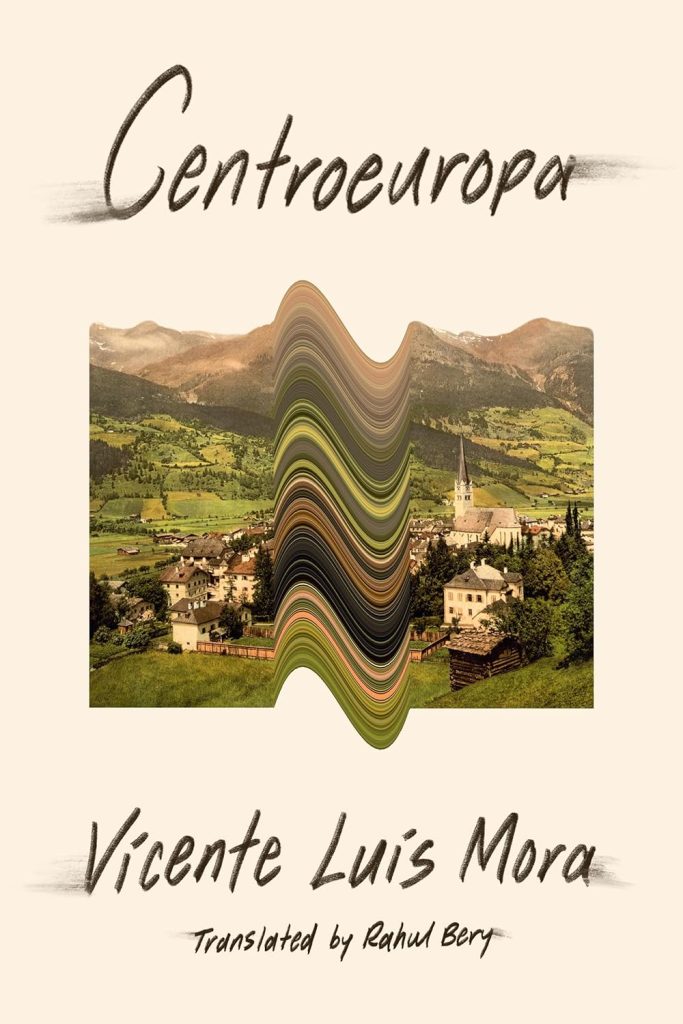
translated from the Spanish by Rahul Bery
original publication (in Spanish): 2020
first English edition: Peninsula Press, 2023
this edition: Bellevue Literary Press, 2026
192 pages
grab a copy here or through your local independent bookstore or library
Centroeuropa reminds me of a series of books I’ve been reading lately, namely Danish author Solvej Balle’s septology on Time, On the Calculation of Volume, for a few reasons. First, they’re both concerned with Time as a concept and also as a kind of material that we can grasp with our hands and examine as if it were a piece of fabric. Second, one might pick up these books thinking that they are reading a work of literary or historical fiction, only to find, a significant way into the book (Centroeuropa or the first volume of Calculation), that this is anything but. These are works of speculative fiction because, as far as we know, corpses do not arrive from the future and one cannot be trapped in a single day, respectively. I make this point because I’ve been reading a lot lately about genre boundaries and seen reviews of Balle’s books that try to ignore the fact that they are speculative.
In fact, I wanted Mora’s book to be even more speculative, but that’s just my taste, and the book as it is is…extraordinary. Set in the beginning of the nineteenth century in a central European town in Germany, Centroeuropa portrays a world coming to terms with the end of feudalism. Yes, the Black Plague chipped away at the feudalistic yoke centuries before, but as with so many things, inertia kept it in place in many areas until it finally died while revolutions raged from the Americas to Europe. Here, Redo Hauptshammer arrives with the coffin of his wife (shot accidentally by a French soldier) in a small town with the deed to a piece of land. This is not just any deed, though–it represents the first freeheld land in the area. Redo is a newcomer, but the residents of the town treat him kindly and he is scrupulous in his manners because he carries a major secret.
Narrated by Redo in the form of a memoir, the novel gives us hints, here and there, about what the nature of the secret might be, but there are bigger issues: Redo starts to dig a grave for his wife on his new land and hits…a corpse. This, he finds, is one of many. Redo then digs up two more, then four, then eight, then sixteen (even I recognized the pattern here!). He doesn’t even bother digging up the thirty-two that he knows are waiting under the surface. When he brings his historian friend Jakob Moltke, Mayor Altmeyer, his neighbor Hans, and various other functionaries to see what he’s discovered, they are all dumbfounded. First of all, each corpse is frozen, and the soldiers inside the ice look as if they had just died–they are completely preserved. Even weirder, though, is the fact that, after they are exposed to the air and the sun, and even as the temperature rises, the ice remains as it was when Redo first dug them up. Makes you think this maybe isn’t ice?
And then we come to the soldiers themselves. According to Jakob: ” ‘I am almost certain that these sophisticated uniforms do not belong to any of those armies [Bohemians, ancient Ugro-Finns, Pomeranians, Austrians, Russians, Roman legions, soldiers from extinct Poland, Cossacks, the French, Saxons [etc.]'” (65) that have fought on the land that Redo now owns. In fact, the sixteen soldiers that they discover seem a bit too sophisticated for even their contemporary times. As the local witch Ilse tells Redo, “‘I knew that one’s daughter. Those ones are French. Those four are from the New March, when it was still Polish. Those ones aren’t from here, they’re from the past. And those sixteen aren’t from here or the past.’ ‘Where are they from, then? ‘The question is not where, but when'” (95). Well.
Redo has a lot on his mind already. This secret he carries is constantly on his mind, and in order to make sure that he can farm his land in peace and get along with the townspeople, he must always remain self-aware. This he realized when he and his wife left the brothel in Vienna where they met: Redo’s mother was the madam of the place and Odra worked there, having been brought as a young girl from Spain. When the two left the brothel to strike out for a new life and freedom, they knew they’d have to conceal anything that would make others shun them. “I became aware of something: if I was going to have friends in Szonden I had to invent for myself a past full of coherent details. To that end, Odra and I always made sure we wrote things down. Big, complex lies can only sustain themselves if they are backed up by an immutable text to return to from time to time, to remember the finer details. If memory is unreliable, invention is even more ductile and treacherous” (87).
Of course, here I was thinking that Redo was an alien, or a robot, or better yet, a traveler from the future! I was really hoping that this was the secret, but of course I’m not going to spoil it here. The major problem for Redo is that he needs to figure out what to do with the bodies. The townspeople all know about it and come to look, but the authorities, going all the way up to the most powerful people in this area of Germany, refuse to give Redo any guidance. They keep telling him to wait to do anything while they deliberate, but that means that Redo is losing crucial planting time, and he finally takes matters into his own hands. After a few failed attempts to move the corpses to other areas, he decides that they will serve as perfect scarecrows to keep the birds and animals away from his beet plants. Burying them up to their waists and scattering them among his crops, Redo has created a nightmarish but successfully-defended farm.
When his friend Jakob protests, Redo explains that ” ‘…I believe they are a lesson, Jakob, as a historian you should understand. It’s an opportunity, now that we are living in times of peace, for Prussians to see or recall the horrors of war‘” (158). The perfectly-preserved soldiers serve as a warning, not just to the birds, but to anyone who walks by. The effects of war, on Redo’s land, are not buried and hidden, allowing people to claim ignorance about the past while starting new wars. Rather, these soldiers serve as a constant reminder about what war does to the people and the land–the violence, the upheaval, the destruction.
This could have been a much longer novel, with Mora dwelling on the various characters at length and exploring the complicated social, political, and economic issues that lie at the heart of the story. That he didn’t is a testament to his sharp focus on telling one very specific and fascinating story. This is Redo’s story, one that shows a character’s intellectual and emotional growth as he navigates a new world and makes new friends. It is a self-aware novel, as well, with a few footnotes that pull the reader out from Redo’s story to remind us that this is a chronicle of a specific time and place. Redo is also constantly referring to the piece he is writing, wondering if he is doing it well and chastising himself for relating things out of order. That his best friend is an historian reinforces the ultimate point of this story that individuals are bound to both their particular historical circumstances and history itself. Because of the coincidence that allowed Redo to purchase the first plot of free land in Szonden, he is able to use the inexplicably frozen soldiers to try and jar his neighbors and friends out of their complacency during a time of peace. After all, as us twenty-first-century dwellers know, early-nineteenth-century central Europe is about to descend into a couple centuries of war that will be more destructive than those that went before.
An engaging, forceful, powerful short novel, Centroeuropa is going to be one of the books I recommend from now on.
Read a conversation between Vicente Luis Mora and his translator Rahul Bery here.
