
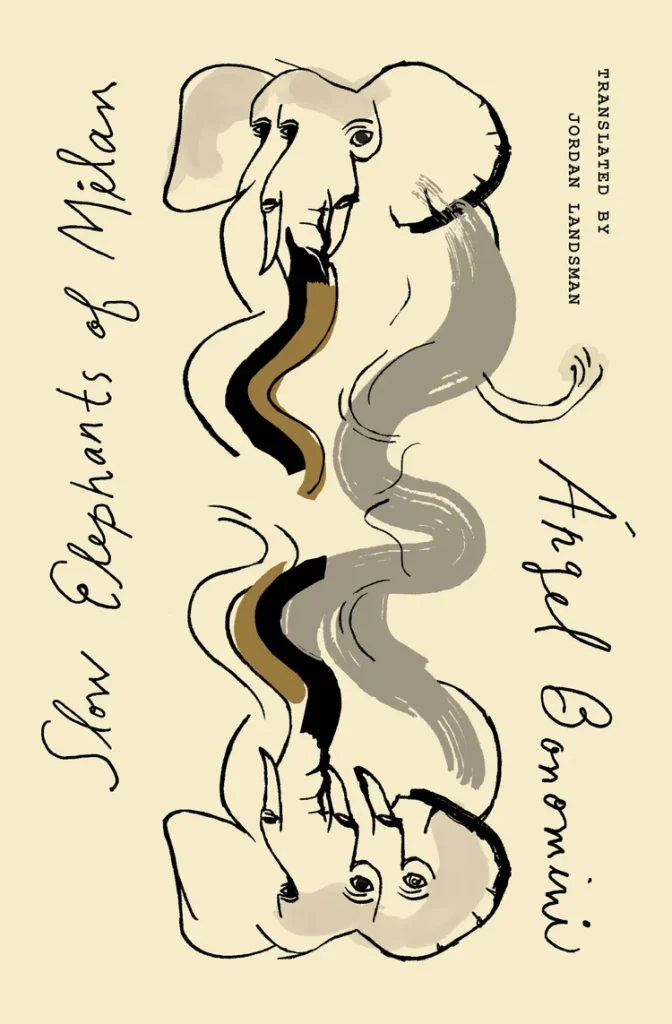
translated from the Spanish (Argentina) by Jordan Landsman
original publication (in Spanish): 1978
this edition: Transit Books, 2026
152 pages
grab a copy here or through your local independent bookstore or library
I thought I was prepared to read Ángel Bonomini’s collection Slow Elephants of Milan when I learned that he was a contemporary of Jorge Luis Borges and Aldolfo Bioy Casares and admired by them. Having read Bioy Casares’s The Invention of Morel many years ago, I was ready for mysterious narratives where I wasn’t exactly sure what was real and what seemed real. But then I read the first story in Slow Elephants and realized that Bonomini was going to be even more enigmatic than that. Reading his stories, for me, was like looking out at the world from inside a fish tank. Everything seems tinted, wavy, not quite stable.
The elephants in the title story keep weaving in and out of the narrator’s vision as he tries (and fails) to think through the sadness that he was dealing with while passing through Milan. Throughout the story, he keeps veering back to these two elephants, whose presence so surprises and disturbs him that he finds himself dwelling on them far longer than he had expected to. Were they being taken to the local zoo? Were they walking down a major street in Milan for some other purpose? And why were so few people surprised by this very odd turn of events? Then again, perhaps the elephants are really just a stand-in for the narrator’s own heavy soul, for he says at one point “My elephants are my elephants. Yet at times I have felt them press on my gloomy heart with their gray velvet feet.”
People, birds, animals, and even landscapes refuse to retain their shapes. In “You Must Go to Laar,” a couple dreamily finds that they have traveled to a place that doesn’t seem to exist and in which they are completely alone. The bird that keeps returning to the narrator’s apartment in “Diary of My Portraits” changes colors each time it arrives. Parallel to this is the fact that the woman who paints the narrator over and over again can’t seem to figure out how to successfully capture his face on the canvas.
In story after story, the narrator’s relationships or inner turmoil color how he is seeing the world, suggesting a intensely subjective perspective that draws the reader into this unstable world. The stability that we do find, however, is, ironically, in the always calm, steady voice of the narrator. He might be perplexed or sad or surprised, but he never stops speaking–we get the sense that language is what Bonomini holds on to, deploying it as a way to try and hold down reality for a second as he captures it on the page. In “Conversation on the Bridge,” two men contemplate what may or may not be a monster rising from the water beneath them as one of the men describes how a blind boy in his town used to know everything about the creature.
The most powerful story, for me, in this collection was “The Reunion,” in which Bonomini’s narrator imagines that his grief over the loss of a woman he loved (but never told of his love) actually warps reality, returning him and his friends to the past, when the woman was still alive. He encounters her once more, on the day he first met her, only this time, her name and appearance are ever so slightly different. And yet, on encountering her brother the next day, he learns that she is, in fact, still dead. The following story, “Women Dressed in White,” takes up a similar theme of two women, one mysteriously mirroring the other.
Because of the beauty of this collection, skillfully translated by Jordan Landsman, I intend to read Bonomini’s other collection in English, The Novices of Lerna, also from Transit Books and translated by Landsman. You can read some of Bonimini’s stories online here and here.
