
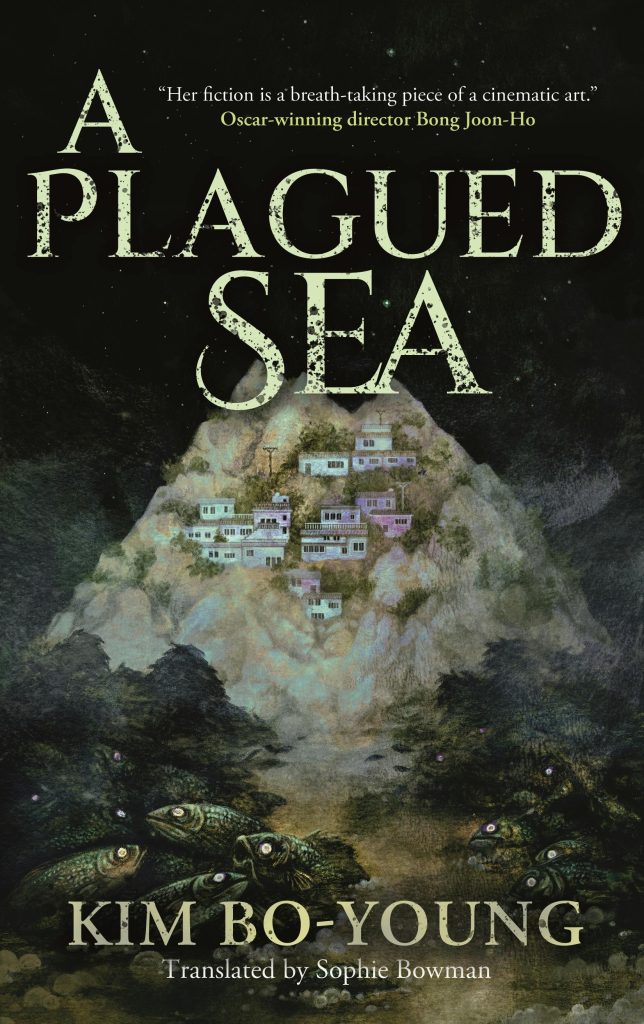
original publication in Korean: 역병의 바다 (Alma, 2020)
translated from the Korean by Sophie Bowman
this edition: Tor Nightfire, 2026
112 pages
grab a copy here or through your local independent bookstore or library
A Plagued Sea, Sophie Bowman’s translation of Kim Bo-Young’s 역병의 바다 , is a work of Lovecraftian cosmic horror set firmly in present-day Korea. This is Kim’s third work in English translation, following Joungmin Lee Comfort and Sora Kim-Russell’s translation of On the Origin of Species and Other Stories; and I’m Waiting for You and Other Stories, Sophie Bowman and Sung Ryu’s translation of three of Kim’s stories from various collections. Bowman, a PhD candidate in the Department of East Asian Studies at the University of Toronto, has also translated the following short speculative fiction texts: Djuna’s “The Second Nanny” (Clarkesworld, 2019), Jeong Soyeon’s “Home” (Guernica, 2019), and “Whale Snows Down” (Future Science Fiction Digest, 2020).
A chilling work of horror by a major Korean science fiction writer, A Plagued Sea was ostensibly written for Honford Star’s “Lovecraft Reanimated” series, given that Kim says in her author’s note that though she had agreed to write something of Lovecraftian horror, she “kept agonizing over one question: ‘What exactly is Cthulhu and cosmic horror?” For Kim, the idea of how horror was experienced by individual protagonists in Lovecraft’s work inspired her conception of A Plagued Sea‘s protagonist and narrator Muyoung, through whom we learn about the disaster that has befallen the seaside village of Haewon.
Muyoung and her young niece are traveling to Haewon for a vacation and board the train just as they learn about a massive earthquake and subsequent tidal wave has devastated the village. Caught in Haewon, they are swept up in the apocalyptic devastation, since the earthquake and tidal wave apparently unleashed a mysterious disease that transforms its victims, causing major deformities and skeletal abnormalities. At first the Korean government and the world believe that the disease is contagious, and so Haewon is locked down (it’s not a coincidence that Kim wrote this tale during 2020). Muyoung remains mysteriously unscathed but she learns that her niece has died in the hospital.
The next three years see Muyoung acting as a security guard for the village, forcibly dragging back to their homes anyone who tries to break quarantine. Most of the villagers have undergone some sort of skeletal change and seem to be comfortable only in very wet, humid conditions. It’s almost as though they’re changing into a strange human-sea-creature hybrid. Questions arise about what exactly is happening in the only hospital in the area and if the director is going to try and make an escape from Haewon.
The sudden appearance of Ha Woojin, a idealistic contagious disease researcher, in the village disrupts Muyoung’s hope that the outside world will allow Haewon to rejoin it in the near future, since the disease doesn’t seem to be killing people, just transforming them. Ha’s appearance coincides with a subtle rumbling in the village, which Muyoung can feel but not quite understand. She knows that something is about to happen, but it’s only when she and the police substation commander learn that a man in the village, thought to be living with his wife all this time, had been dead for a long while, that Muyoung starts to realize the enormity of what has befallen Haewon. Yes, something from the depths has infected the residents and transformed some of them, but other creatures in the village are not human at all…and never have been.
Those residents who had supposedly died in the hospital, Muyoung then learns, had been kept locked up in horrific conditions in the hospital’s basement, her niece among them. The chaotic and fatal aftermath of the residents’ uprising leaves Muyoung no choice but to get word out to the rest of the world the truth about what has been happening in Haewon (before Ha Woojin tells his tale of horror) no matter what. But first, she needs to destroy that evil Cthulhu-esque creature that has been sitting on the outcropping off the coast, brought forth by the earthquake, orchestrating the entire disaster.
A Plagued Sea successfully sets cosmic horror in a Korean village, where, since the disaster,
It seems as though everyone here who ever read The Book of Changes or a fortune telling manual one time has opened up shop. The only methods left for imagining hope are readings of people’s Four Pillars of Destiny and looking up their date of birth in the Tojeong Bigyeol. (20)
Bowman’s decision to translate the Chinese title I Ching (“The Book of Changes”) or 四柱命理 (“Four Pillars of Destiny”) but not Tojeong Bigyeol is confusing–why are only two of the three texts about divination systems, cosmology, and fortune-telling translated into English?* Also, as someone who knows very little about Korean traditions, I would have appreciated a footnote or endnote that explained what these texts were, though I also understand that some translators/publishers/authors find footnotes/endnotes disruptive. That said, it was easy for me to look up these texts myself, which taught me more than a single footnote would have done.
On the other hand, Bowman left in references to Korean social media (“Kakao Talk,” “Daum mesage boards,” “Naver Band”), appropriately leaving it up to Anglophone readers to assume that these are social media sites and web portals similar to what we use in the West. These references allow the reader to more fully immerse themselves in the world of the story, recognizing the ways in which the characters are trying to communicate with one another and the outside world as everything seems to be collapsing around them.
Near the end of the novella, Bowman’s translation of Muyoung’s foray into the water to kill the creature is both fierce and lyrical:
“The darkness that had obscured everything gave way, and my surroundings became rainbow-colored as though fireworks were going off in every direction. The driving rain became indistinct and the sky shone so bright that I had to squint. The sea scattered dazzling light in a kaleidoscope of colors. The strange rock formations of the craggy islet stood out so clearly it was as though I could reach out and touch them. The scene was resplendent, more brilliant than anything I had ever seen.”
I look forward to reading On the Origin of Species and I’m Waiting for You, and I expect to see many more translations of Kim’s work in the future.
* Every time I try to attribute a translation decision to a translator or to a publisher, I’m told it’s the other way around, so I might be wrong when I say it was Bowman’s decision alone.
