
I have just spent a couple of months reading a handful of French sf in translation stories and novels, originally written between the late 1940s and 1970s, and translated into English between 1965 and 1975. This effort is part of a project I’m giving myself to read more deeply in the SFT of a variety of source languages, focusing mostly on the 1960s and 70s. I began with French because of Verne’s major influence on the development of science fiction and because French sf was brought into English in large quantities almost before that from any other source language (except German). It’s been…quite an experience, though I was somewhat prepared by my deep-dive into the work of Pierre Boulle (see that series of essays I wrote several years ago HERE). In preparing to write the essay you’ll find below the list of texts, I also had so much fun (for real, I love this stuff) searching for contemporaneous reviews of these books in Anglophone sf magazines.
Just getting my hands on these books wasn’t easy. I already owned 13 French Science-Fiction Stories, which includes 3 stories I reviewed back in 2016 for Science Fiction and Other Suspect Ruminations. When I turned to my local university library, it disappointed me intensely, holding very few of these books in its collection. Because of annoying issues I won’t get into, I am unable to ILL books even from another satellite campus, so I’m restricted to the one campus and its libraries (and don’t get me started on the public library system. “SFT? What? Huh?“). Between that and the fact that Abe Books actually didn’t have a lot of French SFT either available or for a price less than $387,352,235,235, I whittled my list of “French SFT first published in French between 1960 and 1980” down to the list you see below. There was one other book on the list, originally–Pierre Barbet’s Cosmic Crusaders–but if you follow me online, you’ll know that I was already…not pleased with Barbet’s work. I tried, believe me, to read Baphomet’s Meteor, the first book in the double novel that is Cosmic Crusaders, and, Reader, I could not. It was so bad, so very very bad. More to say on Barbet later. Unfortunately.
Below, I will briefly sketch out what these stories and books were about and offer a general analysis of them and of my own reading experience. I have thoughts, my dear Reader, so come along on the journey.
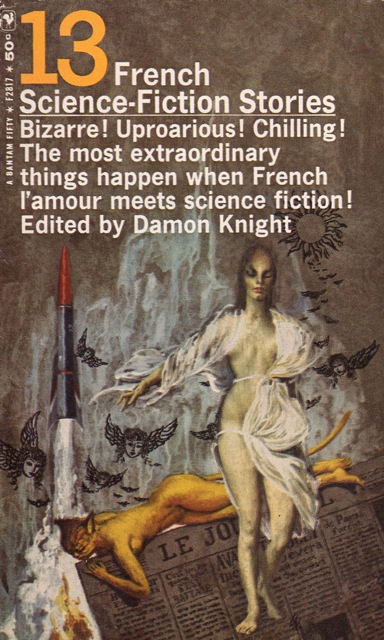
13 French Science-Fiction Stories, edited and translated by Damon Knight (Bantam, 1965)
This uneven anthology of French speculative fiction mostly features stories originally written between the late 1940s and 1960s (with one from 1922). The best stories (and the only ones worth reading, frankly) of the group are by Nathalie Henneberg, Henri Damonti, Gérard Klein, and Claude Veillot and feature everything from psychic alien invaders in Egypt and alien automatons to psychic time travel and alien shapeshifters.
“I think it would have been more true, and likely garnered more interest, if it had been labelled as “disturbing tales that challenge the boundaries of science fiction.” – Galactic Journey

The Green Gods (1961) by N. C. Henneberg, translated by C. J. Cherryh (DAW, 1980)
Earth has been consumed by greenhouse gases and, for a thousand years, plants and insects have taken over the planet, reducing humanity to a small, enslaved population. When the last two royal humans decide to revolt against the plant overlords, they’re joined (belatedly) by humans who had colonized other planets millennia before.
“Very weird fantasy of a future where plants rule men!” – Scottishe 80 (1980)
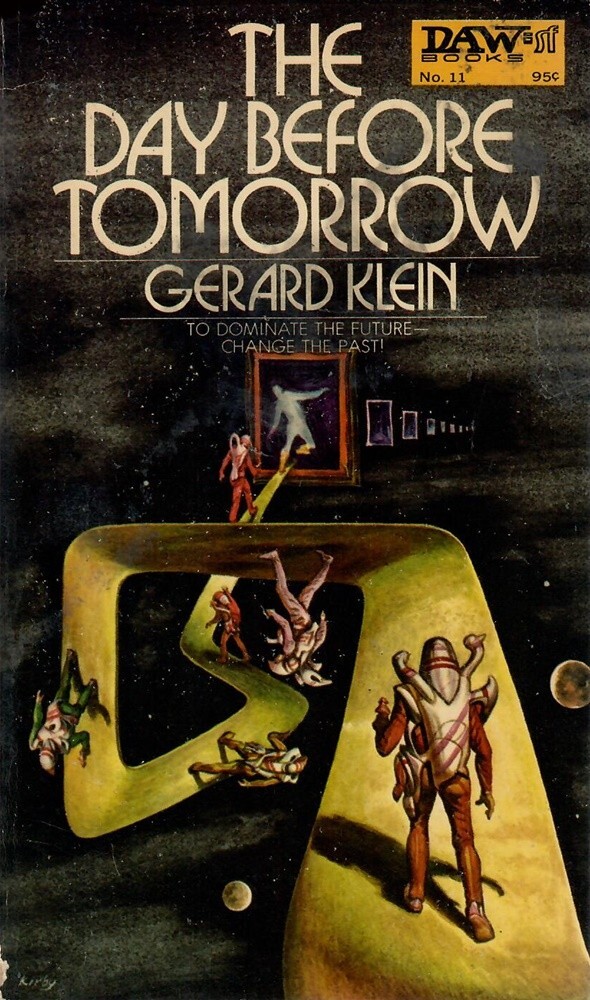
The Day Before Tomorrow (1963) by Gérard Klein, translated by P. J. Sokolowski (DAW, 1972)
The Federation has once again sent out a time-traveling team to adjust a society’s history on another planet in order to preserve the empire’s supremacy. This time, however, the team encounters a city and people that shake up everything they’ve ever believed about their mission and undermines the Federation’s very foundation.
“[It’s] the first novel to deal with the paradoxes of time travel on the complex level of Heinlein’s ‘Bootstraps’ and ‘Zombies’.” – Luna Monthly (1971)
[Marc Purcell also does a profile of Klein in Luna Monthly March 1972]
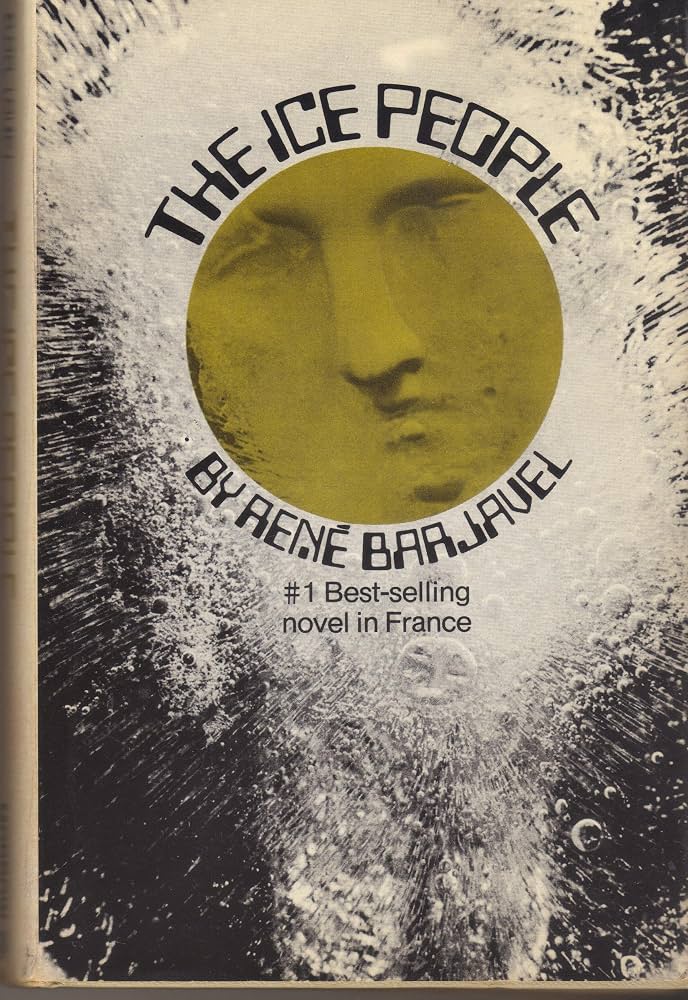
The Ice People (1968) by René Barjavel, translated by Charles Lam Markmann (Rupert Hart-Davis 1970)
Scientists discover the ruins of an ancient civilization under the Antarctic ice, as well as two survivors of the apocalyptic event that ended it. As the world watches, the scientists attempt to revive the ancient couple and learn what happened to them and their people.
“A lost Atlantis beneath Arctic ice with enough ardor to melt it, plus some inventive gadgetry and contemporary parallels.” – Kirkus (1970)
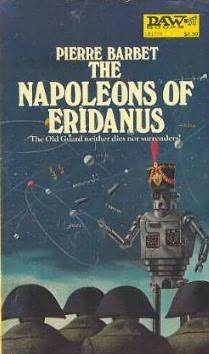
The Napoleons of Eridanus (1970) by Pierre Barbet, translated by Stanley Hochman (DAW, 1976)
A group of Napoleon’s soldiers caught in a Russian snowstorm following a battle wander onto an alien ship and are then taken to the Eridanus system, where a race of aliens called the Fortruns ask them to defeat an aggressive alien race trying to invade their planet. The Fortruns, who have uploaded their brains to robot bodies, are in fact controlled by powerful computers, whose aims come into conflict with the humans’ battle strategies. Once the human soldiers begin to pile up victories, the head of the army decides to turn his guns back on the aliens who kidnapped him and his fellow humans.
“In plot if not in theme, this is similar to Poul Anderson’s High Crusade, but Anderson did it much better. This is moderately entertaining space-opera.” – Yandro (1976)
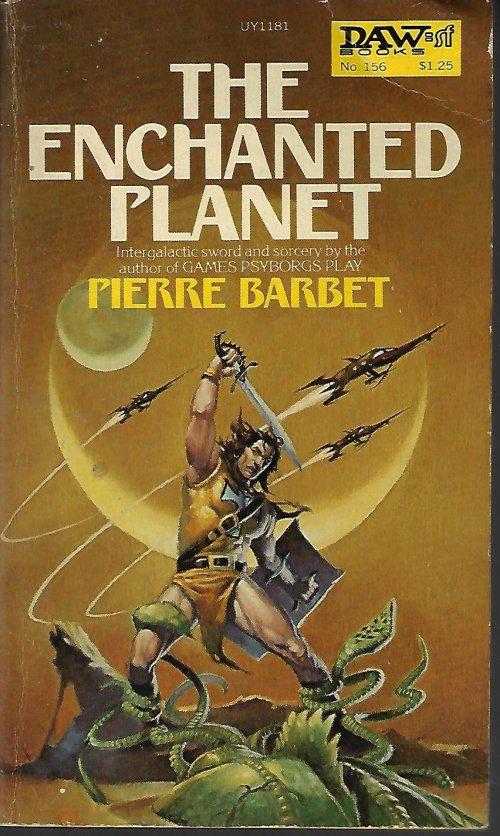
The Enchanted Planet (1973) by Pierre Barbet, translated by C. J. Richards (DAW, 1975)
An astronaut (Setni, from Barbet’s previous book Games Psyborgs Play) is given a task by said psyborgs to go to a mysterious planet that has just appeared in the Milky Way to figure out where it has come from. Setni discovers a race of powerful telepathic beings that have taken over another galaxy and seek to do the same to the Milky Way. It is up to Setni to stop them.
“The Enchanted Planet raises again the question whether this type of fantasy-piece should be labeled sf.” – Luna (1976)
In “Science Fiction in France: An Introduction,” George Slusser, writing for Science Fiction Studies in November 1989, talks about the post-World War II period in French sf and the French reaction (in the 1960s and 70s) to American pulp magazines (251). The resulting French sf, which included, among other things, an embrace of Philip K. Dick’s work, resulted in “a turn from speculation on tomorrow and elsewhere…to protest in the here and now; exploration of inner rather than outer space’ concern with ecology and the human system of limits; and on the opposite–nightmare–side, fascination with mind control, paranoia, and political and material oppression.” With the rise of the French version of the Magazine of Fantasy and Science Fiction, Gérard Klein (as critic) encouraged French authors to imitate Theodore Sturgeon and Ray Bradbury. According to Slusser, “Fiction was the ‘workshop’ for the French writers (Klein included) who produced [Arthur] Evans’s renaissance of the 1960s and 70s. And its vision emerges naturally in contrast to a pulp American vision in which these critics see the resurgence of perhaps the only enemy the Cartesian tradition has known since its inception in the 17th century: that materialist positivism so often associated with the name of Verne” (252).
The 1960s and 70s witnessed a massive influx of short- and long-form French SFT. Seven of French sf author Pierre Boulle’s novels were published in English between 1963 and 1986 by Vanguard, and, as I note in my essay on his work, “a man writing about the issues of his time, Boulle explores the connections between science and religion, the pressures of technology on the environment, the violence simmering just under the surface of human civilization, and the 20th century quest to finally reach the moon.” He was best known in English for Planet of the Apes, but only by reading several of his books in quick succession could I see that “through it all, Boulle shows how some seemingly-perfect solutions to the world’s problems, taken to their logical conclusions, become disastrous.” Case in point: Desperate Games, which remains one of my favorite novels. It is not beautifully written, it is not lyrical or uplifting. It is downright bonkers and suggests a cynical yet clear-eyed view of human nature that endeared me to Boulle. Basically, scientists solve the world’s problems and expect people to thank them and then build a utopia. What actually happens is exactly what you’d expect (and what many authors before Boulle and since have written). People are…ungrateful. They don’t know what to do with themselves, so these brilliant leaders need to figure out how to keep them busy and happy. No Huxley-brand Soma here. No happy slogans. Just, you know, world-wide gladiator games that morph into nuclear reenactments. You read that right. It’s ridiculous, it’s over-the-top, and it’s eminently entertaining.
I think I was expecting more Boulle-like novels when I started this project, and of course I quickly realized how wrong I was. As in any language, authors may be writing around the same time, in the same language, and in the same genre but craft incredibly diverse stories that draw on an infinite number of themes and styles. Damon Knight’s 13 French Science Fiction Stories (which he translated) offers an interesting microcosm of the kinds of French sf being written between the 1940s and 1960s, including stories about cars like Kit in Knight Rider, beautiful alien women who distract men so much that society can’t function, and a man who joins a time-travel club (that last one was actually pretty good). Kris Vyas-Myall reviewed this anthology for Galactic Journey several years ago, and I am pretty much of the same mind about these stories. The anthology is very uneven, with “Juliette” (the car story) reading like something a talented 7-year-old would write and the stories by Klein and Henneberg knocking it out of the park, as usual. One gets the sense, as I’ve gotten with Wollheim and Barbet, that there was this desire back then just to get as much French sf into Anglophone readers’ hands no matter the quality. I am sure this happened with other writers and other languages. Once you’re on a roll with something good and popular (like Boulle’s Planet of the Apes), you want to load everyone down with more. I mean, think about the Verne craze.
Once I got into the first novel of this series, C. J. Cherry’s translation of Nathalie Henneberg’s The Green Gods, I started noticing some trends. Henneberg must have been a massive favorite with Damon Knight (and I totally get it, she was brilliant) because he included three of her stories in 13 French Science Fiction Stories, more than any other author. These stories are wild: interstellar travel, mysterious aliens with telepathic powers, mental time travel; even Leonardo da Vinci makes an appearance! And then there’s The Green Gods. You won’t believe me when I tell you what it’s about but I’m going to tell you anyway. So the Earth experienced a terrible cataclysm hundreds of years ago and now plants have become the dominant species. They’ve developed telepathic powers (by which they communicate with the few humans that are left on the planet) and they’re supported in their efforts to colonize the entire planet by gigantic insects, which have grown so large because of the greenhouse gases that have allowed flora and fauna to flourish unchecked. Characters in The Green Gods are very much aware of the past and how it has shaped the present; the humans are determined to fight against the plants and their insect servants in order to regain their freedom. And while many humans had long ago fled the Earth and established colonies on other planets, and some of these humans have returned to Earth to try and help their trapped compatriots, it is up to the last of the humans (who happen to be royalty) to truly free their minds and go to war against the plants. Cherryh’s translation offers us prose that is verdant in every sense of the word: it includes long, lush descriptions of the various plants and their parts, as well as the overgrown Earth that we would no longer recognize. One might, of course, wonder if this is Cherryh’s choice to represent Henneberg in this way, but then you think about Damon Knight’s translations of Henneberg’s stories in the anthology and you see that, no, this is Henneberg. Cherryh and Knight have captured, albeit slightly differently, of course, Henneberg’s unbridled, descriptive prose that laughs at boundaries. Unfortunately, I couldn’t get my hands on any reviews of The Green Gods in American magazines of the time. If you find any, please send them my way.
P. J. Sokolowski’s translation of Klein’s The Day Before Tomorrow (originally titled in French “Time Has no Smell”) is so different from The Green Gods in style and plot that it’s quite jarring. Told in a colder, more logical tone, Klein’s story follows a team of seven highly-trained time travelers whose job it is to manipulate other civilizations so that the Federation they work for will always be in control of the galaxy. Here, time is malleable, and the travelers eventually learn that the man who discovered time travel realized that, in the Federation’s hands, the ability to manipulate civilizations would be catastrophic, so he set up a situation in which the Federation would collapse. Most of the story is set on a very Henneberg-like planet, where the trees are apparently in control and give the few humans living there all that they need in both physical and psychological terms. Mark Purcell, in Luna Monthly (December 1971), reviewed the book as he read it in the original French, offering readers a thorough description of the plot, calling it “the first novel [he’s found] to deal with the paradoxes of time travel on the complex level of Heinlein’s ‘Bootstraps’ and ‘Zombies’.” In the end, Purcell spends a bit of time talking about the potential American and British influences on Klein, wrapping up with the conjecture that “perhaps Ballard and Klein underwent a parallel artistic development, each in his own literary world of s-if.” In an issue a few months later, Purcell does a Klein profile, considering some of Klein’s short stories that haven’t yet been published in English.
At one point in Klein’s novel, one of the travelers finds himself on what looks like another planet and it includes giant vegetation and bugs. Did I mention I hate bugs, especially giant bugs? Here I started seeing a theme…
Next up was Charles Lam Markman’s translation of René Barjavel’s The Ice People, a straight-up science fiction thriller. This is the story of a group of scientists discovering an ancient civilization (and a couple of well-frozen people) beneath the ice of Antarctica. What blows everyone’s minds is the fact that all measurements suggest that this civilization existed nearly a million years ago. Barjavel spends a lot of time, especially in the beginning of the novel, depicting various countries in the UN arguing over the find, and then sending out spies to find out what the other superpowers know. The scientists, an international team, squabble among themselves a lot (one Soviet scientist keeps yelling at her “imperialist” colleague with whom we can all see she’s in love, obviously). When Barjavel hauls out the technology, though, the believability starts to collapse. A universal translator makes it so that the scientists can work well together: ok, that’s fine. But then one of the ancient people is woken up (the woman) and she puts on some kind of headgear that can translate her memories into images that are then sent to a tv that everyone can watch. The rest of the novel is Elea’s memories of the apocalypse that befell the Earth when her country and the other superpower on the planet went to war with what sound like nuclear weapons. Barjavel makes sure he takes up a large figurative club near the end of the novel and slams it down on our figurative heads repeatedly, making sure we know that world war is bad, nuclear weapons are bad, and we humans just need to find a way to get along with one another.
At this point, I see you wiping your brow and saying “whew! At least there were no giant bugs in this one!” But now that I write this, I have this nagging feeling that there was one brief scene in which there was overly-large vegetation and there might have been some bugs…but don’t quote me on that.
Some reviewers were not happy with this novel, though they did manage to give it a lot of page-time. Steven Dimeo in Riverside Quarterly (1975) titled his review “Pulp on the Rocks” and unloaded on the novel right away: the book, he says, “strains to unearth the Rip Van Winkle motif and succeeds only in resurrecting a story that would have been better had it remained buried. The book is not only scientifically but literarily imbecilic.” Though it begins well, Dimeo argues, “what might have at the very least been an interesting tale exploring the discrepancies of Darwinian discoveries and the whys of human existence, what could have been a more chilling than chilled tale of scientific discovery, becomes simply a waste of time.” Kirkus was a bit more positive, though the reviewer couldn’t bring himself to come up with more than a cursory summary and the final judgment, “amusing.” My response to these reviews? Accurate.
And now we come to the novels of Pierre Barbet that I was actually able to wade through. Yes, wade through. I don’t even want to think of what Steven Dimeo would have done to Barbet’s Napoleons of Eridanus, Enchanted Planet, and Cosmic Crusaders. Ok, yes, Barjavel’s novel is pretty extreme in its unbelievability and overt in its manipulation of reader expectations, but at least there’s a coherent plot and the story moves pretty quickly (except for some of Elea’s interminably long flashbacks). Barbet’s novels can best be characterized by the word “bad.” I simply can’t understand why Donald Wollheim bought not one, not two, not three, but seven Barbet novels for translation into English. Each of his novels (except for two) has a different translator, making me wonder, of course, if each translator worked on a book and then said “NO MORE” or if Wollheim wanted to spread the love, or…? From my cursory glance around the fanzine world around the 70s, I find that Barbet showed up at various conferences, and was a guest of honor at some. According to a piece translated from the French by Don Wollheim (thanks to The Atomic Elbow on Bluesky for this!) (Locus #139 April 14, 1973), “the largest SF gathering in France” happened, and guess who was there: Barbet, Jacques Sternberg, J. P. Andrevon, and others. Basically, he was everywhere, and yet in Neil Barron’s Anatomy of Wonder (third edition), Maxim Jakubowski, writing about French SF, doesn’t mention Barbet once. NOT ONCE. Klein, Henneberg, Barjavel, sure. No Barbet. I’m not surprised.
Stanley Hochman’s translation of The Napoleons of Eridanus starts off well, but degenerates very quickly. Here, a band of Napoleon’s soldiers, making their cold way back from the front lines in Russia in 1812, stumble upon what looks like a weird-looking hot air balloon. They wander into it, of course, and find themselves trapped on an alien spaceship. Conveniently, when the aliens wake up, they telepathically explain to the soldiers that they (the aliens) need the soldiers to help them fight a war with yet another aggressive alien race. The French soldiers agree but only if they have carte-blanche, and I think you can guess where this is going. The characters are flatter than a piece of paper, and the handling of the female characters is pretty shameful. The reviewer for Yadro (1976) noted that “in plot if not in theme, this is similar to Poul Anderson’s High Crusade, but Anderson did it much better.”
I had already ordered a bunch of Barbet off of Abe Books, so I gingerly moved on to C. J. Richards’ translation of The Enchanted Planet. Again, it starts off fine, interesting premise, etc. And then it falls off a cliff. Apparently, you needed to have read Barbet’s previous novel Games Psyborgs Play to understand this novel at all (a novel that the writer of Schlock Value absolutely rips to shreds, something very much deserved). So the astronaut Setni encounters a strange ship adrift in space, and when he goes to check it out (remember Napoleons?), he’s contacted by the Psyborgs, who want him to investigate this odd planet that just popped into the Milky Way out of nowhere. When Setni is transported to this strange planet, he’s suddenly in a medieval story, and he speaks this stilted Middle English that seriously made me wonder what the language was like in the original French. Perhaps Richards wanted to follow the very bad French and make the English equally cringy, or maybe Richards thought they were keeping the English in line with the French but it turned out cringy? Other parts of the translation were quite odd, including strange rhyming within a single line and very awkward constructions. When I see that (and honestly, I rarely encounter that in translations I read–they’re usually very well done), I start to wonder about the quality of the translation, on top of the quality of the original novel.
I just never learn, so on I moved to Bernard Kay’s translation of Baphomet’s Meteor (the first book in the double novel Cosmic Crusaders), which immediately turned into a dense treatise on the Crusades and the Knights Templar’s strange pact with an alien that is strangely similar to what people thought were demons. I absolutely love history and science fiction that weaves it in well, but after fifty pages of the Knights Templar feuding with other Crusaders in the Holy Land and these absolutely ridiculous–ridiculous–moments wherein various kinds of technology are just pulled out of nowhere to do heavy plot lifting, I just couldn’t take it anymore. I may or may not have thrown the book across the car.
Thus I must beg to differ with Mark Willard in Science Fiction Review (Winter 1981) about the…well…quality of Cosmic Crusaders. He apparently thought it was a, and I quote, “fun book!” A reviewer for The Alien Critic (1973) titled his review of Baphomet’s Meteor “Cometose [sic] in the Middle Ages.” Reader, you must understand, I’m one of those anal people who absolutely must finish a book they’ve started, otherwise it feels like something’s wrong with the universe. I’ve only DNF’d a book like 3 times in my life so far (I’m not fortysmmmmnmsnmnmn years old) and I. Could. Not. Get. Past. Page. 50. of Baphomet’s Meteor. That, my friends, was it for Barbet and me. No more. NO MORE.
Oh, and remember that bug theme that runs through these works of French SFT I’ve been reading? Well, the aliens that are trying to take over the Milky Way in The Enchanted Planet are actually these giant crustaceans that look like giant bugs.
So some major themes here: 1) giant bugs, 2) hand-wavy telepathy. Reading these six works of French SFT has been an entertaining experience, and, coupled with my reading of Boulle, has given me a fascinating, if still limited, window onto what was being translated from the French in the sf world. Stay tuned for my next “SFT: In Depth” series on German SFT of the 60s and 70s. I expect it to be just as entertaining as this one.
