
translated from the Portuguese by the author
this edition: Tordotcom, 2026
160 pages
grab a copy here or through your local independent bookstore or library
Hache Pueyo writes in Portuguese and English, with her first story published in Luna Station Quarterly (in English) in 2016. I first heard about her in 2018, when her translated story “Sea-Crowned” came out in The Dark Magazine. Since then, I’ve read some of her stories, and each one has been tight, gripping, horrifying, and excellent. Last year, her first long-form text came out in English translation–But Not Too Bold, and, alas, I haven’t yet read it. But when I received a copy of Cabaret in Flames, I pushed it to the top of my pile.
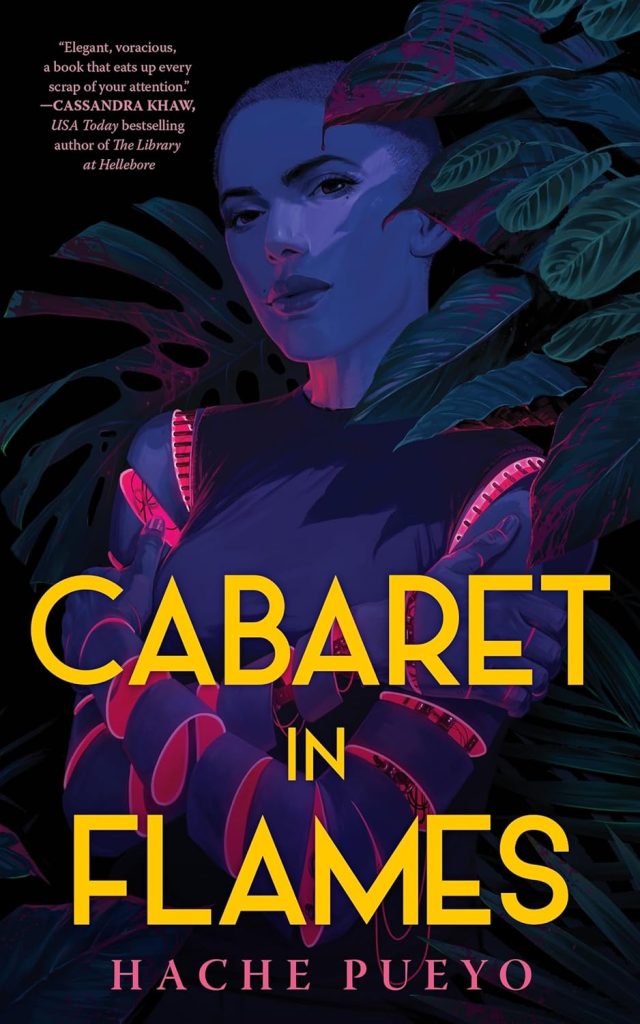
The protagonist’s story in Cabaret is so awful that I’m afraid it made it so that I can’t ever really say I like this book. But that’s why I don’t usually read horror. However, Pueyo is that good of a writer that you just can’t stop reading her once you’ve started. In Cabaret, a young woman named Ariadne gets a visit from a mysterious and sophisticated gul, who’s looking for his friend Erik. Guls, you see, are creatures who live among humans all over the world and have throughout time (think vampires, but guls eat people, they don’t just suck their blood). We piece together, over time, that Ariadne (not her real name) was rescued from a house in which a gul named Minotauro had gathered a bunch of kids and feasted on them, one limb at a time. Erik, a man who knew guls and tried to turn himself into one (because of their regenerative properties), brought a limbless Ariadne out of that house and nursed her back to health, crafting synthetic limbs and skin for her and teaching her what he knew about treating guls (ironically).
Then a gul named Quaint shows up, looking for Erik, and thus begins an adventure in which Ariadne accompanies the gul to the capital. Something strange has been going on with the president and his advisors, and Quaint and Ariadne start to think that there’s gul business going on. And that it involves Erik. Along the way, Ariadne has to try and handle her horrific trauma while trying to figure out if she can trust Quaint. She was devastated when Erik left her unexpectedly in the clinic (presumably to go to the capital) and now she doesn’t know what she’ll say to him if/when she finds him. Quaint introduces Ariadne to a host of new guls, including a pregnant Rafaela, who, it turns out, is married to the man who brutalized Ariadne. I won’t spoil anything for you, but let’s just say, Erik and Quaint make sure that Minotauro never bothers anyone again.
This horrifying story is told in a matter-of-fact tone, from Ariadne’s perspective, suggesting that she has flattened everything she remembers in an effort to get through each day. There’s an energy to the writing, too, one that propels the plot forward and makes the reader interested in the protagonist’s destiny. And then there’s just beautiful writing like this:
She also wanted a connection–any connection–between the Erik she knew and the one Quaint new, a unifying factor between two seemingly opposing forces: his Erik, her Erik, and the real Erik, who belonged only to himself. (122)
Yes, it’s a horrifying story, and the budding relationship between Quaint and Ariadne doesn’t seem very organic, but the story is interesting, the writing is excellent, and the descriptions of Ariadne’s synthetic limbs and skin are well done. For anyone interested in horror fiction or anything to do with vampires/vampire-like creatures, I would highly recommend this short novel.
