
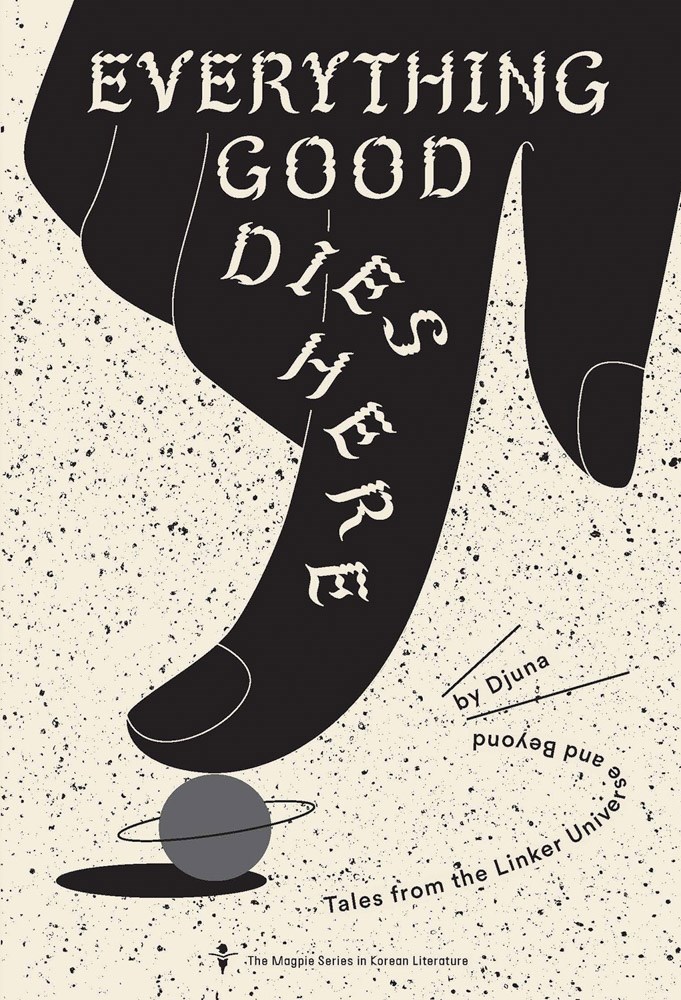
translated from the Korean by Adrian Thieret
Kaya Press, 2024
grab a copy here or through your local independent bookstore or library
This collection of science fiction stories and a novel (itself made up of linked stories) has my brain reeling. Djuna is a master of complicated storytelling, where multiple characters and events and motivations swirl together in a brilliant mix. One of the major science fiction authors to come out of Korea this past decade, Djuna reinforces for us Anglophone readers that if we really want to know what science fiction looks like in our current world, we need to regularly look beyond our borders. Like Bae Myung-hoon, Kim Choyeop, Bora Chung, and Kim Bo-young, Djuna explores what might happen when humans actually spread out beyond Earth to explore the universe, as well as how we might change ourselves with highly-advanced technology. Thanks to Adrian Theiret, Anton Hur, and Sophie Bowman, we are able to read Djuna’s work in the jaunty, confident English that makes us both forget that these stories were originally written in another language and encourages us to read as much Djuna as we can.
Djuna’s “Notes from the Author” and Thieret’s “Translator’s Afterword” at the end of Everything Good offer us crucial context for understanding Djuna’s style and how we can fit this collection and other works by Djuna in a larger context of Korean SFT and SFT in general. Djuna gives us insight into their approach to these eclectic and engaging stories, explaining at one point: “While I do enjoy worldbuilding, I try to avoid spending too much time in a single world (a lesson I learned from reading Asimov’s later works). I’d rather write a variety of stories set on a variety of worlds” (448). Old Hollywood movies, which had an enormous influence on Djuna in their younger years, form a backbone for many of these stories, especially those set in the alternate-evolutionary Linker universe explored in the linked stories of Jezebel. Translation (the Hollywood movies Djuna devoured) is thus a major influence on Djuna’s craft, and they are well-aware of the complexities involved in bringing a work of art from one language into another. Djuna also explains that they used to read more American sf in Korean translation but, “these days, the situation has flipped. Last year, I read more native Korean SF than English-language SF–a situation I would never have imagined possible” (450-51).
In Thieret’s afterword, he traces Djuna’s rise to the development of Korean internet culture in the 1990s, where Djuna started writing film criticism and then fiction. According to Thieret, Djuna’s stories, because they include Korean, non-Korean, and alien characters according to what is called for in the story, offer us an “estrangement effect [that] arises primarily from the fantastic settings and events within the narratives themselves” (458).
No matter what these stories are actually about (alien machines, the internet, strange holes under the bed), they are fundamentally about writing itself. So often the reader will encounter a sentence (or variant of it) like “Let me tell you a story.” Narrators refer to their own stories as stories. They’ll say, “what are my ultimate plans, you ask?” or “were I a more experienced storyteller…” Language, translation, crafting a tale–these themes never let us forget that what we are reading is something created by a person attempting to make sense of the universe. Djuna seems to love the idea of linked stories, and perhaps this is why their “Linker Universe” is so named. The virus in the Linker Universe changes everything it comes into contact with, bringing forth new and strange variations in species that humans can’t make sense of but just need to accept. Often in this collection, stories will throw out vague references to the stories that came just before.
Colonization, something that Korea knows all too well in its traumatic history under Japanese occupation in the early 20th century, runs throughout Everything Good, as it does in several works of recent Korean SFT. Part I of this collection includes five stories (not set in the Linker Universe) that explore variations on these themes. “The Rabbit Hole” features a human who has been adopted by aliens it can’t ever fully understand, but the hole under its bed into another universe? dimension? suggests that there is more to the girl’s new life than she had thought. “Through the Mirror” gives us a taste of what’s to come in the Linker stories (which make up Part II of the collection) when an alien jungle spreads its particles from an alien to humans when that alien travels to Earth. The word “link” appears, in fact, emphasizing that the colonizer and the colonized are now forever intertwined.
“Under the Sphinx,” a story about an invented old Hollywood movie that takes on a life of its own, has taken its place on my list of favorite stories of all time. The slowly-inching absurdity of this tale made me immediately think of French author Pierre Boulle’s novels and stories, especially Desperate Games. This has to be my favorite sub-sub-genre: an event occurs, like someone placing a fake IMDB film or scientists trying to solve the world’s problems, and completely unexpected things occur. Djuna wants us to consider that we really can’t control or get ahead of much in life–we need to adapt to what comes to us, and do it intelligently. Randomness and absurdity will assail us, yes, but we don’t have to be their victims. Believe me, this story is a masterclass in fiction writing.
Part II, which includes two Linker stories and Jezebel, made up of four more stories, imagines that alien machines have landed on Earth at some point in the future. They seem uninterested in humanity, only in using the resources of the planet (including the humans they need) to conduct some sort of operation that humans can’t understand. Some enterprising people board various machines and find themselves traveling throughout the universe, landing on and colonizing new planets and evolving after generations into forms that they would never have foreseen. The stories in Jezebel, in particular, focus on the trials and tribulations of a crew of a ship that bears that name. Cruising around on a planet named Crusoe, it encounters alien machines that are acting strangely, android dolls that can receive downloaded human consciousness, new religions, and much more. One could write an entire book just on the themes and style of Jezebel. Suffice it to say, it deserves multiple re-readings.
I’m truly looking forward to the next Djuna in English, Not Yet Gods, which has experienced a few unexplained delays. Hopefully it will be available soon (the date right now is June 2026). I encourage you to read Counterweight, Everything Good, and the stories they have in Clarkesworld. You’ll thank me!
