
translated by Julia Sanches
original publication (in Spanish): 2023
this edition: Coach House Books, 2026
grab a copy here or through your local independent bookstore or library
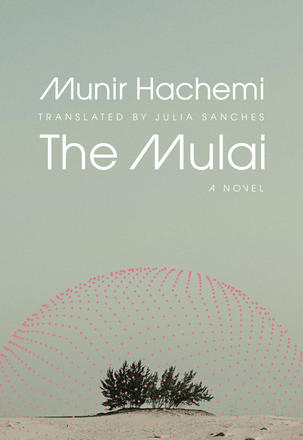
The Mulai is an intriguing polyphonic novel about language, translation, human culture and adaptation, religion, history, and the search for meaning. Unlike most of the other Spanish-language SFT we’ve received in the past couple of years, Hachemi’s novel takes place on another planet, leading the reader, at first, to think that this will be a story about space travel and colonization. One quickly realizes, though, that this is a story about a specific, alien place that has influenced the people who settled there, just as much as the people (after just a couple of generations) have shed some of the language they came with, forgot and then semi-rebuilt their religious traditions, and learned to understand the weather cycles and ecology of their new home.
One of the elements that makes The Mulai especially compelling is its multi-layered structure: the text itself is constructed out of notes kept by Spanish archaeologist Nahum Cordovero, as well as notes, translations, and other texts written down by Faida and Sheipa, each of whom has broken Mulai taboos and, ultimately, advanced the Mulai’s and Cordovero’s understanding of what happened to this group of human colonists who were tasked with settling a new world more than a century before.
The Mulai very quickly reminded me of Argentine author Teresa P. Mira de Echeverría’s novella Memory (2015, translated from the Spanish by Lawrence Schimel) about a new human society that has developed on Mars centuries after genetically-engineered humans were sent there to terraform the planet. In Memory, some humans are now working toward reversing that terraforming process while embracing the formerly-ostracized engineered colonists and developing a new approach to love and family structures. In Memory as in The Mulai, binary relationships have given way to family units that are three (the latter) or more (the former), with children raised by the entire community. Utopian in their approach, both novels imagine that these small colonies have stopped caring about private property or individuality and live in a more fluid, generous way with one another.
Religious belief is central to The Mulai, with Cordovero noting the colonists’ dedication to “Dog” (God?) and “the tree” (The Tree of Life from Genesis?), as well as Faida’s journey to the “Temple” (which might be the original ship that brought the colonists a century before) and the colonists’ chanting of sentences that might be a looped recording from a robot (Hachemi refuses to clarify any of these questions, instead insisting that the reader participate in the uncertainty and interpretation). Faida’s fascination with the manuscripts in the scriptorium and her slow but determined efforts to interrogate the Mulai’s religious beliefs made me immediately think about Élisabeth Vonarburg’s In the Mother’s Land (1992, translated from the French by Jane Brierley), in which one woman, after discovering manuscripts about the history of Maerlande, realizes that the religious teachings she learned in childhood are very different from what she’s reading in the texts unearthed in a centuries-old prison. As I said in that review, what In the Mothers’ Land “is really about… is how we understand our past and the ways in which we create historical and religious narratives in order to explain it.”
Cordovero and Faida spend a lot of time trying to capture and wrestle down the Mulai language before finally accepting that it will never be held in a particular shape. While our languages here on Earth change and evolve over the centuries, language changes by the hour in the Mulai community, and papers are never bound together but mixed up, annotated, ripped, burned, and reorganized, reflecting a society that has found a way to live on another planet in an unexpected way. Hachemi’s characters go into great detail about what translating Mulai into Spanish, for instance, would even look like. As Hachemi says in his Acknowledgements, The Mulai is a book about translation, and the layers of translation that he unfurls throughout are fascinating. The translator herself, Julia Sanches, is even included as a character near the end:
“Excerpt from the journal of one of the first Mulai. Translated into Mulai or invented in Mulai, or both, by Faida, re-translated from Mulai into Spanish by the Archaeologist [Cordovero] and translated into English by Julia Sanches, Circa the year 200, before the end of the supply containers.”
One has to imagine that the original colonists brought a wide variety of religious beliefs, since Faida’s journey has Christian overtones and some of the Mulai’s prayers may be drawn from Islam. Ultimately, the outsiders (Faida, Sheipa, Cordovero) offer us insight into a culture that has settled in the domes their ancestors set up, adapted to their circumstances, and rigidly adhered to their beliefs and traditions as if determined to keep the rest of the planet at bay.
We only learn about what actually led to the creation of this Mulai community here and there in the text, but eventually it sounds like a crew was sent to settle an alien planet and then forgotten as environmental wars raged back on Earth; for decades, the colonists received shipments of food because its delivery was automated, but even that stopped. The Mulai became farmers, but still adhered to the practice of only eating food that has been dehydrated, in keeping with the original shipments of dehydrated, canned goods.
Julia Sanches’ translation of a novel steeped in translation reveals just how dedicated and creative translators must be to wrestle with language and then present it in a form that the target readers can understand and appreciate. The Mulai is, indeed, polyphonic, and holds a mirror up to our own cultures, inviting us to think about how we use language and what we might do if forced to adapt to another environment.

1 comment on “Review: The Mulai by Munir Hachemi, tr by Julia Sanches”