
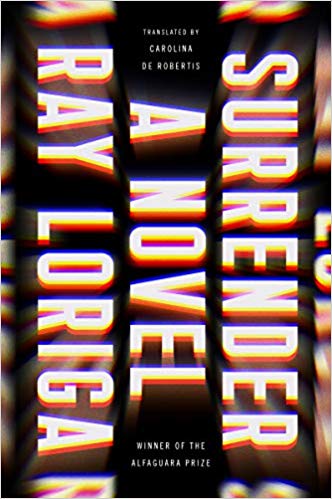
translated from the Spanish (Spain) by Carolina De Robertis
original publication (in Spanish): Rendición, 2017
this edition: Mariner Books, 2020
211 pages
grab a copy here or through your local independent bookstore or library
* Rendición won the Alfaguara Prize for 2017 (awarded to a work written in Spanish that has never before been published)
*
[I’m going to put it out there–this is the first review I’ve written since delving deeply into the issue of how to respectfully review translations. While I intend to write an essay that details some of the ways in which a reviewer can get themselves into a “translation mindset,” this review is coming before that essay, so what better way to walk the walk, as they say?]
To the book that’s in my hand: Carolina De Robertis’s translation into English of Ray Loriga’s Rendición (Surrender, in De Robertis’s translation) is a dystopian story about a man and his family who are forced by their government to flee an unseen enemy and live in a crystal city. De Robertis, an author of both fiction and nonfiction in English, has translated several works of Latin American literature (according to her website), including Chilean author Alejandro Zambra’s Bonsai (2006, tr 2008) and Argentine author Marcos Aguinis’s The Passion According to Carmela (2008, tr 2018). Unfortunately, Surrender does not include any translator’s note or introduction. As far as I can tell, Rendición has also been also been translated into Arabic (byمحمد الفولي in 2019) and Turkish (by Süleyman Doğru in 2020). Loriga’s only other work in English translation so far is Tokyo Doesn’t Love Us Anymore (2004), translated by John King from Tokio ya no nos quiere (1999).
“Choice”: this word does a lot of work both in the task of translation itself and in Surrender. According to a Spanish-to-English dictionary I accessed, “Rendición” could mean a wide range of things: surrender, rendition, accounting, submission, capitulation, etc. De Robertis’s choice of “surrender” for the title leans into what the narrator (in whose head we stay for the entire novel) feels like he is doing by agreeing to everything the “zone inspector” (who passes down orders from the government) tells the people of the region to do: burn down your own house, pack a bag, and prepare to move to a crystalline city (reminiscent of the glass city in Yevgeny Zamyatin’s dystopian classic We (1924)). Surrender means to give up and accept defeat. Is this what the narrator believes he is doing?
But there’s that word “rendition” there, and “accounting.” Why didn’t De Robertis choose one of those? I can’t know without asking, but the multiplicity of meanings adds a fascinating dimension to this story. The entire tale is one man’s accounting of (rendition of?) what has happened to him and his family- as he explains near the end of the book, he is telling this story to his son during brief fits of wakefulness after being beaten up by the authorities. The unnamed narrator is always (nearly every other page) underscoring how little he knows and how his wife, who used to be his employer, taught him how to read and write well, and thus imagine more vibrantly and think more clearly.
The choice of “surrender,” though, seems to be done with confidence, since the word “surrender” appears about every 50 pages in this slim novel, as if to remind us that this is the core concept of the story. The narrator considers what it means to surrender- is it cowardly to do as you’re told when you have no choice except to do it or face death? Should one nonetheless fight against one’s chains, even if it means death?
When the narrator and his wife are told to leave their farm with the other region’s residents to move to a safe city (as the war drags on), they decide to hide the fact that the mute boy they’ve been sheltering isn’t their biological child (their two sons left for war and haven’t been heard from in years). They need to come up with a story about the boy for the authorities so that they won’t take the child from them. As the narrator explains, his wife “says that it’s the story that matters and not the reality that binds it” (34-5). He adds that “since she’s much more intelligent than I am, I listen to her about everything…” When this wife turns on him and begins having an affair with a man from the crystal city, the narrator is then thrown upon his own resources once more, as he had been before he married her. His instincts, to anyone who is cheering for him to escape (as this reader did), seem perfectly intact, even with his wife no longer in the picture.
Surrender is one steady-handed account of a man trying to adjust to an alien life. As is familiar to anyone who has read or watched dystopian, apocalyptic stories, this family starts off traveling in a group but winds up arriving at the crystal city alone. They’re then taken in as refugees and given all of the necessities of life free of charge. Of course, the narrator feels like this is all too good to be true, but he’s glad that his family is safe. Ironically, he is given the job of hauling human feces back and forth to the recycling plant. One can’t help but read into this that the narrator is literally doing what he thinks he is also metaphorically doing: hauling around crap in his mind to help himself get through each day. Everything in this city is transparent (so no one has any privacy), there is only daylight, and no one has any reason to strive for anything. I was reminded of Pierre Boulle’s scathing critique of a society like this in his novel Desperate Games (1971), translated from the French by Patricia Wolf in 1973. In that novel, once scientists have figured out how to make people perfectly happy, those same people start committing suicide because they have nothing to live for.
Not surprisingly, the narrator chafes against this life, and the cracks are some of the most interesting parts of the story, since the narrator is often trying to persuade himself that it’s fine, everything’s fine, and then…
Overall, these people’s idea of modesty was downright nuts. That’s what I was thinking about, as well as where to find a goddamn bar around here, when I ran into a familiar face.
(114)
The eruption of “nuts” and “goddamn” is just like a crack in the armor that the narrator’s been wearing as best he could. Eventually, he realizes that the “crystallization” process they’ve all been put through must be making him feel this horrible happiness–a joy that is so overwhelming, he can’t even bring himself to get angry at his wife taking this lover into her bed and kicking him to the couch. Only when he stops showering thoroughly and drinking the water (he tries to drink only beer for a few days) does he manage to work up a fury, which makes him feel better, because it’s more natural.
The story is focused so closely on the narrator telling us what has happened to him that every other character, except Julio, the mute son, seems unreal or paper-thin. Readers might immediately flag this as the story of an unreliable narrator, but we’re never able to see outside of the narrator’s mind. No city names or languages are given and the only references to place involve weasels and other small animals, farmland, and forests. We know we’re reading about an unspecified future because people have wrist implants that tell them the news and track their loved ones’ life signs.
An updated warning about panopticons, totalitarianism, and collective surrender in the vein of We, Kallocain, 1984, and Brave New World, Surrender is worth the read.
