
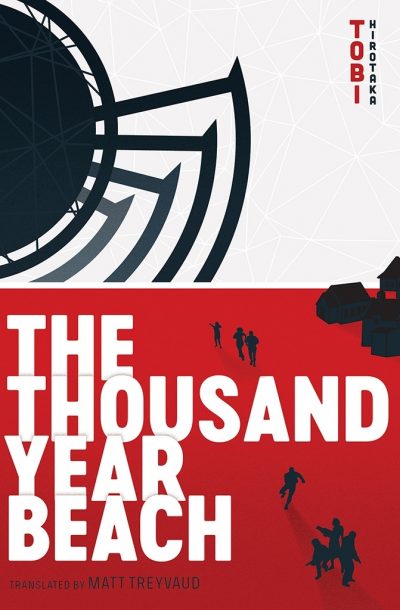
translated by Matt Treyvaud
original publication (in Japanese): 2002
first English edition: 2018, Haikasoru
352 pages
grab a copy here or through your local independent bookstore or library
**spoilers**
“What does it mean to remember? What is a memory?” (79).
Thus opens Chapter 3 of Tobi Hirotaka’s sf-horror novel The Thousand Year Beach (skillfully translated by Matt Treyvaud), a story of AIs living in a virtual resort town that was abandoned by humans over a thousand years ago. Known as the Grand Down, this event was never explained to the inhabitants of the Realm of Summer (part of the vast resort complex known as the Costa del Número), so they have continued living out their lives, wondering where all of the guests went and if they’ll ever return.
In an interview with Paul Semel after the novel’s publication in English in 2018, Tobi explains that
The Thousand Year Beach isn’t much of a cyberpunk story at all. It starts out like a classic European movie, then switches gears to become a monster horror movie, then you get supernatural battles more akin to a Japanese manga or anime. As it progresses further, it becomes a lurid and serious drama. Finally, its conclusion raises such literary themes as the ethical issue of consuming exploitative entertainment and how one can mentally survive in a closed-off and abusive environment.
Memory, love, fear, and abuse are some of the major themes explored in this complicated story, which veers quickly into body horror. Indeed, TTYB reminded me of Sato Yuya’s Dendera (also published by Haikasoru), in which another group of people (this time old women in a mountaintop community) must band together to fight off a hungry bear. Sato’s graphic depictions of the battles are difficult to read. So, too, are Tobi’s descriptions of the AIs’ battles against the giant Spiders that invade the Realm of Summer.
Just after the Spiders arrive, the narrator muses about the nature of memory and the AIs’ relationship to it. In fact, each AI has been given a set of memories in order to develop their personality, which was meant to make the human experience at the resort more enjoyable:
The AIs knew, of course, that their memories had never really been played out in the Realm. They knew that the experiences that had formed their personalities were imaginary. And they knew that these things had been built into them simply for the guests to take an interest in. For all that, the AIs cherished these memories as their very own, priceless and irreplaceable. But– But had those events truly never happened? If so, why could the AIs remember them? How was it possible? (80)
As a few of the main characters learn, their memories are based on a template from the dysfunctional Clement family (which never existed). They were the founders of the Realm of Summer, and the abuse and cruelty that they displayed to each other were the foundation for the virtual resort and the warped relationships among the AIs.
It was deep in the system that regulated AI memory (the ChronoManager) that the AI who would destroy the Realm first appeared. Calling himself “Langoni,” he set in motion a horde of monster Spiders that would destroy the Realm. Based on the small repair Spiders that moved around the Realm fixing minor problems in the code, the giant Spiders come in many different forms, some with only legs, some so small that they are nearly invisible. They begin eating the mountains and the AIs, forcing a small band to hole up in the Mineral Springs Hotel for a final stand. It just so happens that those AIs who made it to the hotel are the ones best equipped to use Glass Eyes–magical instruments, each with a different personality, that allow the characters to alter the Realm on a small scale. With these Eyes, AIs like Julie, Yve, and the triplet sisters are able to fashion a “TrapNet,” using some of the spider silk they harvested from the creatures that they were able to destroy.
This Net, however, quickly succumbs to the Spiders’ attacks, though the AIs powering it don’t realize this until it’s too late. The narrator details how each of the individuals or groups of AIs are destroyed by the Spiders, with characters pulled apart and “killed” in other ways.
Woven into this narrative is a disturbing storyline about the purpose that the resort actually serves. As Langoni explains to José, the character whose personality holds the complex AI relationships in a careful balance:
The Realm of Summer’s an attraction that’s meant to balance nostalgia for the humanity and style of a very low-tech era…and the sadistic urge to crush that innocence underfoot. Your characters are the perfect foils for human users. The guests come here practically giddy with anticipation, knowing that this backwater village is theirs to overrun, and that they will never be held to account for their sins. (260)
This is what Tobi meant in the interview mentioned above when he talked about “exploitative entertainment.” When human guests virtually entered the resort, they would take up a role (“father,” “brother,” etc.) and then treat the characters in their “family” however they wanted. In most cases, as we learn, the human guests were psychologically and physically abusive. Something happened to them, though, over a thousand years ago, and the AIs have been living alone ever since.
Langoni’s entrance onto the scene, though it brings destruction, also brings some answers. According to him, when the humans stopped coming to the realm, their agents (informational simulacra) were destroyed all at once, resulting in the Glass Eyes that are found all over the Realm of Summer. And now, as Langoni explains, the Glass Eyes that helped form the Net are going to do something else for the entire virtual resort: save it from the mysterious Angel that seems to be systematically destroying the other Realms. Langoni himself doesn’t understand who or what the Angel is, but he used the Realm of Summer as a guinea pig for helping him learn how to trap that creature.
A disturbing, at times horrifying, story of cruelty, exploitation, and the interface of humanity and technology, The Thousand Year Beach is a fascinating addition to the corpus of Japanese speculative fiction in translation.
